
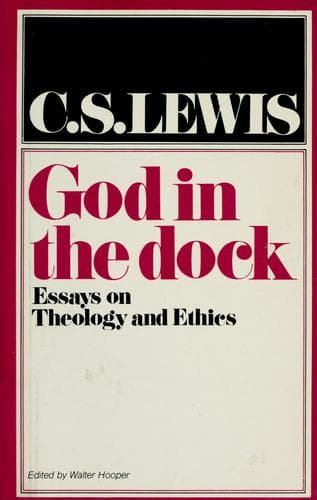
God in the Dock: Essays on Theology and Ethics
الله في قفص الاتهام: مقالات في اللاهوت والأخلاق
Dieu au banc des accusés : Essais sur la théologie et l'éthique
Editorial summary
This posthumous collection assembles forty-eight of C.S. Lewis's shorter theological writings from 1940 to 1963, presenting his defense of Christian orthodoxy against modern skepticism. The title metaphor captures Lewis's central concern: in contemporary culture, God stands trial while humanity sits in judgment, reversing the proper relationship between Creator and creature. Lewis argues this inversion characterizes the spiritual malaise of modernity.
The essays divide into three sections addressing theology, ethics, and apologetic method. In the theological pieces, Lewis defends core Christian doctrines including the Incarnation, miracles, and biblical authority against naturalistic reduction. His essay "Myth Became Fact" exemplifies his approach, arguing that Christianity uniquely combines mythic resonance with historical factuality. Against Rudolf Bultmann's demythologization program, Lewis maintains that removing supernatural elements eviscerates the Gospel's essential claims.
The ethical writings apply Christian principles to contemporary issues including vivisection, capital punishment, and humanitarian theory in criminal justice. Lewis consistently argues that abandoning traditional Christian ethics for ostensibly enlightened alternatives produces inhumane results. His critique of the humanitarian theory of punishment demonstrates this pattern, showing how therapeutic models of justice, despite benevolent intentions, strip human dignity by treating moral agents as patients requiring cure rather than responsible beings deserving retribution.
Throughout, Lewis employs his characteristic method of translating theological concepts into accessible language without sacrificing precision. His essay "Christian Apologetics" theorizes this approach, advocating translation of Christian truth into contemporary idiom while avoiding both obscurantism and modernist accommodation. He particularly opposes scholarly theologians who, in attempting relevance, empty Christianity of distinctive content.
Lewis positions himself against several intellectual currents: logical positivism's dismissal of religious language as meaningless, existentialist theology's subjectivization of faith, and progressive Christianity's cultural capitulation. His positive case rests on rational argument, imaginative appeal, and moral intuition working in concert. The collection demonstrates Lewis's conviction that orthodox Christianity remains intellectually defensible and existentially compelling precisely because it challenges modern assumptions rather than conforming to them.
These essays significantly influenced evangelical apologetics, establishing argumentative strategies still widely employed. Lewis's integration of reason, imagination, and moral sense offers a distinctive approach to natural theology, one that acknowledges post-Enlightenment challenges while maintaining confidence in Christianity's truth claims and their accessibility to rational demonstration.
Argument formulations engaged
Lewis, C.S. (1970). God in the Dock: Essays on Theology and Ethics. Eerdmans.
@book{god-in-the-dock-essays-on-theology-and-e,
  author    = {Lewis, C.S.},
  title     = {God in the Dock: Essays on Theology and Ethics},
  year      = {1970},
  publisher = {Eerdmans},
  url       = {https://god-database.com/en/works/god-in-the-dock-essays-on-theology-and-ethics-1970}
}