
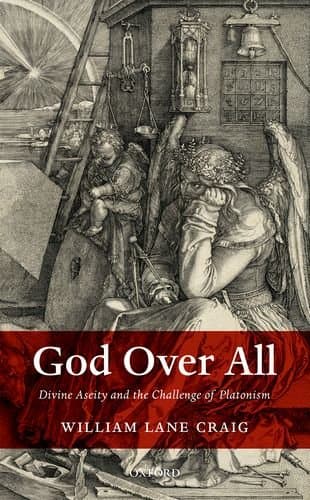
God Over All: Divine Aseity and the Challenge of Platonism
الله فوق الكل: الوجود الإلهي الذاتي وتحدي الأفلاطونية
Dieu au-dessus de tout : L'aséité divine et le défi du platonisme
Editorial summary
Craig's monograph presents a systematic defense of divine aseity against the challenge posed by Platonism regarding abstract objects. The work addresses a fundamental tension in contemporary philosophy of religion: if abstract objects such as numbers, sets, and propositions exist necessarily and independently of God, then God cannot be the sole ultimate reality upon which all else depends. This apparent conflict between traditional theistic commitments and the widespread acceptance of abstract objects motivates Craig's comprehensive examination.
The author structures his argument in three main movements. First, he articulates why Platonism poses a genuine threat to classical theism, demonstrating how the existence of uncreated abstract objects would compromise divine sovereignty and aseity. Craig engages extensively with contemporary philosophers of mathematics and metaphysics, showing how standard Platonist arguments from indispensability and singular terms lead to conclusions incompatible with robust theism.
Second, Craig evaluates various proposed solutions to this dilemma. He examines and ultimately rejects several strategies, including absolute creationism (the view that God creates abstract objects), divine conceptualism (identifying abstract objects with divine thoughts), and modifications of divine aseity. His analysis reveals the philosophical costs of each approach, particularly focusing on problems of bootstrapping and vicious circularity that plague creationist solutions.
Third, Craig defends his preferred resolution: anti-realist approaches to abstract objects. He argues for a deflationary view of truth and reference that allows mathematical and logical discourse to function without ontological commitment to abstract entities. Drawing on fictionalist and figuralist strategies in philosophy of mathematics, Craig contends that we can preserve the utility of abstract object talk while denying that such talk commits us to Platonism.
The work's significance extends beyond narrow debates in philosophical theology. Craig demonstrates how questions about God's nature intersect with fundamental issues in metaphysics, philosophy of mathematics, and philosophy of language. His treatment engages seriously with non-theistic philosophers while maintaining apologetic aims, showing how theists might navigate contemporary philosophical terrain without abandoning traditional divine attributes.
By defending anti-realism about abstract objects on primarily theological grounds, Craig offers a distinctive contribution to debates typically dominated by purely philosophical considerations. The monograph exemplifies how theistic commitments can motivate and constrain philosophical theorizing, while challenging the assumption that Platonism represents the default rational position.
Argument formulations engaged
Related works
Craig, William Lane (2016). God Over All: Divine Aseity and the Challenge of Platonism. Oxford University Press.
@book{god-over-all-divine-aseity-and-the-chall,
  author    = {Craig, William Lane},
  title     = {God Over All: Divine Aseity and the Challenge of Platonism},
  year      = {2016},
  publisher = {Oxford University Press},
  url       = {https://god-database.com/en/works/god-over-all-divine-aseity-and-the-challenge-of-platonism-2016}
}