
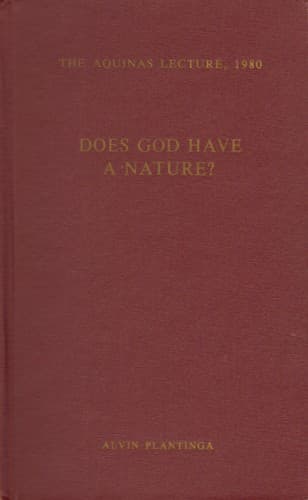
Does God Have a Nature
هل لله طبيعة؟
Dieu a-t-il une nature ?
God's sovereignty over all things is compatible with the existence of abstract objects and necessary truths, provided one carefully distinguishes what God is from what God has, and recognizes that divine nature does not constitute an external constraint on God.
Editorial summary
This monograph represents a sophisticated defense of theistic coherence against the challenge that divine attributes generate logical contradictions. Plantinga examines whether God possesses a nature—understood as essential properties that constrain what God can do—and how this relates to divine sovereignty, simplicity, and necessary existence. The work engages directly with the medieval debate between Aquinas and Duns Scotus while addressing contemporary analytic concerns about modal logic and property theory.
The central problem Plantinga addresses emerges from an apparent dilemma: either God has a nature that includes necessary properties (such as being omniscient, omnipotent, and perfectly good), or God does not. If God has such a nature, then there appear to be abstract objects—properties—that exist independently of God and constrain divine action, seemingly compromising divine sovereignty. If God lacks a nature, then God appears to have no essential properties, rendering traditional divine attributes merely contingent and undermining classical theism.
Plantinga navigates this dilemma by developing a nuanced position that preserves both divine sovereignty and essential divine attributes. He argues that while God indeed has a nature consisting of essential properties, these properties need not be understood as abstract objects existing independently of God. Drawing on insights from contemporary modal metaphysics, he suggests that properties can be understood in ways that do not compromise divine aseity—God's self-existence and independence from all else.
The monograph critically engages with "divine simplicity" as articulated by Aquinas, arguing that the strongest versions of this doctrine lead to incoherence. However, Plantinga maintains that rejecting absolute divine simplicity does not require abandoning the coherence of theism itself. He demonstrates how God can possess distinct properties without being dependent on abstract objects, thereby preserving divine sovereignty while maintaining the meaningfulness of distinct divine attributes.
This work significantly advances analytic philosophy of religion by showing how contemporary metaphysics can illuminate classical theological problems. Plantinga's careful analysis demonstrates that apparent incoherence in the concept of God often results from conflating distinct philosophical issues or accepting false dilemmas. His approach exemplifies how rigorous analytic methodology can defend traditional theistic commitments while acknowledging genuine philosophical difficulties. The monograph remains influential in discussions of divine attributes, abstract objects, and the coherence of classical theism within analytic philosophy.
Structured analysis
Argument formulations engaged
Related works
Plantinga, Alvin (1980). Does God Have a Nature. Marquette Univ Press.
@book{does-god-have-a-nature,
  author    = {Plantinga, Alvin},
  title     = {Does God Have a Nature},
  year      = {1980},
  publisher = {Marquette Univ Press},
  url       = {https://god-database.com/en/works/does-god-have-a-nature}
}