
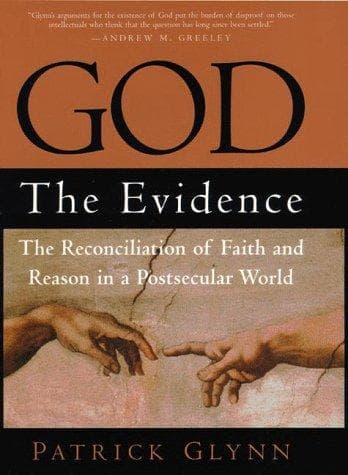
God, The Evidence.. The Reconciliation of Faith and Reason in a Postsecular World
الله، الدليل.. التوفيق بين الإيمان والعقل في عالم ما بعد العلمانية
Dieu, la preuve.. La réconciliation de la foi et de la raison dans un monde post-séculier
The collapse of secular materialism and the convergence of scientific, psychological, and philosophical evidence point toward a reconciliation of faith and reason in a postsecular age.
Editorial summary
Patrick Glynn's "God, The Evidence: The Reconciliation of Faith and Reason in a Postsecular World" presents a comprehensive case for theism grounded in developments across multiple scientific disciplines since the 1960s. Writing from within the Christian analytic tradition, Glynn argues that contemporary scientific discoveries have fundamentally shifted the intellectual landscape in favor of belief in God, marking what he terms a "postsecular" turn in Western thought.
The work's central thesis posits that materialism, which dominated intellectual discourse throughout much of the twentieth century, has been progressively undermined by empirical findings in cosmology, physics, medicine, and psychology. Glynn employs a cumulative case methodology, weaving together distinct argumentative threads to construct what he presents as a compelling evidential framework for theistic belief. His approach combines rigorous philosophical analysis with accessible presentation of scientific data, targeting both academic and educated general audiences.
In the domain of cosmology, Glynn develops a sophisticated version of the fine-tuning argument, examining the anthropic principle and the precise calibration of physical constants necessary for life. He engages critically with multiverse hypotheses and other naturalistic explanations, arguing that these alternatives require greater faith than theistic interpretation. His treatment of the cosmological argument focuses particularly on Big Bang cosmology and its implications for creation ex nihilo, directly challenging steady-state theories and eternal universe models.
Beyond traditional natural theology, Glynn ventures into more controversial territory by examining near-death experiences and documented cases of miraculous healing. While acknowledging the methodological challenges these phenomena present, he argues that their cumulative weight, when subjected to rigorous scrutiny, provides additional evidential support for transcendent reality. This interdisciplinary synthesis distinguishes his work from more narrowly focused philosophical treatments of God's existence.
The monograph's significance lies in its timing and scope. Published during a period of renewed interest in science-religion dialogue, it challenges the prevailing narrative of inevitable secularization. Glynn's integration of scientific findings with philosophical argumentation exemplifies the analytic tradition's commitment to rational discourse while maintaining openness to theistic conclusions. His work engages directly with prominent atheistic thinkers including Carl Sagan and Stephen Weinberg, offering detailed rebuttals to their naturalistic worldviews. The text ultimately serves as both an apologetic resource and a scholarly contribution to ongoing debates about the relationship between scientific knowledge and religious belief in contemporary intellectual culture.
Structured analysis
Structure of the work
Argument formulations engaged
Glynn, Patrick (1997). God, The Evidence.. The Reconciliation of Faith and Reason in a Postsecular World.
@book{god-the-evidence-the-reconciliation-of-f,
  author    = {Glynn, Patrick},
  title     = {God, The Evidence.. The Reconciliation of Faith and Reason in a Postsecular World},
  year      = {1997},
  url       = {https://god-database.com/en/works/god-the-evidence-the-reconciliation-of-faith-and-reason-in-a-postsecular-world}
}