
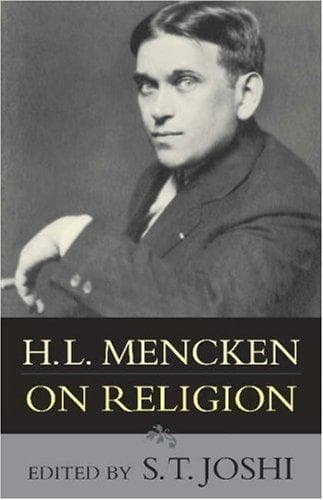
H. L. Mencken on Religion
ه. ل. منكن عن الدين
H. L. Mencken sur la religion
Editorial summary
This comprehensive anthology assembles H. L. Mencken's most significant writings on religion, revealing the Baltimore journalist as one of the early twentieth century's most caustic critics of religious belief and practice. Joshi's editorial selection demonstrates how Mencken deployed wit, satire, and cultural criticism to assault what he viewed as the intellectual bankruptcy of religious faith, particularly American Protestant fundamentalism. The collection spans Mencken's career from the 1910s through the 1940s, encompassing newspaper columns, magazine articles, and excerpts from his books, most notably his coverage of the 1925 Scopes Trial.
Mencken's critique operates on multiple levels. Philosophically, he dismisses religious belief as incompatible with scientific rationality and modern knowledge, arguing that theology represents a primitive stage of human understanding superseded by empirical investigation. Sociologically, he attacks organized religion as a force for conformity, censorship, and cultural stagnation, particularly targeting the anti-intellectual tendencies of American evangelicalism. His analysis of the Scopes Trial exemplifies this approach, portraying fundamentalism not merely as wrongheaded but as actively hostile to civilizational progress.
The volume reveals Mencken's debt to nineteenth-century freethinkers and his alignment with contemporary skeptics, though his critique differs from philosophical atheists through its emphasis on cultural rather than metaphysical arguments. Unlike systematic philosophers who engage theological arguments on their own terms, Mencken treats religious belief as a sociological phenomenon best understood through its effects on American society. His method combines journalistic observation with literary ridicule, creating a genre of religious criticism that influenced subsequent cultural critics.
Joshi's editorial apparatus contextualizes Mencken's anti-religious writings within broader debates about secularization, modernization, and American identity during the interwar period. The collection demonstrates how Mencken's religious criticism intersected with his libertarian politics and cultural elitism, revealing tensions between his defense of individual freedom and his contempt for democratic masses whom he viewed as naturally inclined toward superstition.
The anthology's significance lies in documenting a distinctly American form of religious critique that eschews philosophical argumentation for cultural combat. Mencken emerges not as a systematic atheist philosopher but as a cultural warrior whose influence on American secularism operated through journalism rather than academic discourse. His legacy appears in subsequent generations of public intellectuals who similarly employ media platforms to challenge religious authority through ridicule rather than reasoned dialogue.
Argument formulations engaged
Related works
Joshi, S. T. (2002). H. L. Mencken on Religion. Prometheus Books.
@book{h-l-mencken-on-religion-2002,
  author    = {Joshi, S. T.},
  title     = {H. L. Mencken on Religion},
  year      = {2002},
  publisher = {Prometheus Books},
  url       = {https://god-database.com/en/works/h-l-mencken-on-religion-2002}
}