
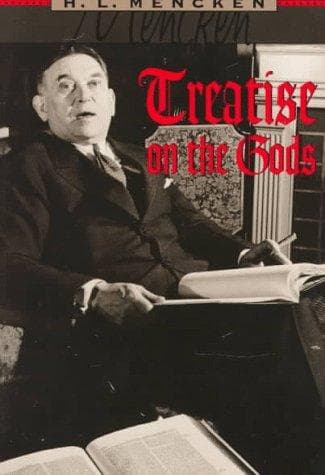
Treatise on the Gods
رسالة في الآلهة
Traité sur les Dieux
Editorial summary
This work presents a sweeping anthropological and psychological analysis of religious belief, examining the origins and persistence of divine concepts across human societies. Mencken approaches religion as a natural phenomenon arising from primitive human psychology, arguing that gods emerge from humanity's fundamental fears and desires rather than from any transcendent reality. The treatise traces religious development from animistic beginnings through polytheism to monotheism, presenting this progression as a gradual sophistication of essentially illusory beliefs.
The author employs a naturalistic methodology, drawing on anthropological evidence, historical analysis, and psychological speculation to construct his account. Mencken argues that religion originates in primitive humanity's terror before natural forces and continues through a combination of psychological need, social utility, and priestly manipulation. He treats all religious systems as equally unfounded, viewing Christianity merely as one mythology among many, distinguished only by its particular historical success rather than any superior truth claims.
Central to Mencken's argument is his contention that religious belief represents a failure of human reason. He portrays faith as fundamentally incompatible with scientific thinking and modern knowledge, characterizing believers as either intellectually limited or willfully deluded. The work particularly targets Christian theology and American religious culture, which Mencken sees as especially anti-intellectual and socially harmful.
The treatise engages critically with contemporary defenses of religion, rejecting both fundamentalist claims to literal truth and modernist attempts to reconcile faith with science. Mencken dismisses theological philosophy as sophisticated sophistry designed to preserve untenable beliefs. He argues against William James's pragmatic defense of religion's psychological benefits, maintaining that comforting illusions ultimately damage human progress.
This work's significance lies in its comprehensive articulation of militant atheism during the early twentieth century. Mencken's combination of evolutionary thinking, psychological reductionism, and satirical prose established a template for popular atheistic criticism that would influence later writers. His emphasis on religion as a purely human creation, explicable entirely through natural causes, anticipates later cognitive and evolutionary approaches to religious studies. While the work's polemical tone and speculative anthropology limit its scholarly value, its cultural impact in promoting skeptical attitudes toward religion remains substantial. The treatise stands as a landmark expression of confident secularism between the World Wars.
Argument formulations engaged
Related works
Mencken, H. L. (1930). Treatise on the Gods. University of Chicago Press.
@book{treatise-on-the-gods-1930,
  author    = {Mencken, H. L.},
  title     = {Treatise on the Gods},
  year      = {1930},
  publisher = {University of Chicago Press},
  url       = {https://god-database.com/en/works/treatise-on-the-gods-1930}
}