
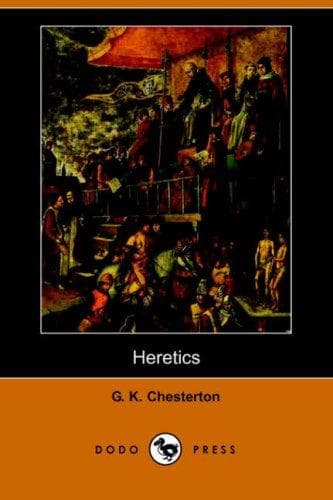
Heretics
المهرطقون
Hérétiques
Editorial summary
This collection of essays represents Chesterton's systematic critique of what he perceives as the intellectual heresies of early twentieth-century thought, particularly those that undermine traditional Christian belief. Written as a response to prevailing modernist philosophies, the work examines various contemporary thinkers and movements that Chesterton considers fundamentally misguided in their approach to truth, morality, and the divine.
The text engages with multiple intellectual currents, including the skepticism of George Bernard Shaw, the pessimism of Arthur Schopenhauer, the imperialism of Rudyard Kipling, and the rationalism of H.G. Wells. Chesterton employs a distinctive methodology that combines paradox, wit, and common sense to expose what he sees as the internal contradictions of these modern philosophies. His central argument maintains that these contemporary heresies share a common defect: they abandon the balanced orthodoxy of Christianity for extremist positions that ultimately prove self-defeating.
Throughout the work, Chesterton develops his critique of materialist and determinist worldviews that exclude divine purpose from human existence. He argues that modern skeptics, in their rejection of religious dogma, have merely substituted new and more restrictive dogmas. The author particularly targets the notion that scientific progress and rational analysis alone can provide adequate foundations for human meaning and morality. His defense of orthodoxy emerges not through systematic theology but through demonstrating the practical and philosophical failures of its alternatives.
The work's significance for the God debate lies in its distinctive apologetic strategy. Rather than offering direct proofs for divine existence, Chesterton argues that atheistic and agnostic worldviews fail to account for fundamental human experiences such as wonder, joy, and moral conviction. He presents Christianity not as one philosophy among many but as the uniquely balanced worldview that preserves both reason and mystery, order and freedom.
This text establishes themes that would be fully developed in Chesterton's subsequent work "Orthodoxy" and influences later twentieth-century Christian apologists. Its method of defending theism through cultural criticism rather than philosophical argumentation represents an important alternative approach within religious discourse. The work demonstrates how orthodox Christian belief can be defended not through retreat from modernity but through direct engagement with its leading intellectual representatives.
Argument formulations engaged
Related works
Chesterton, G. K. (1905). Heretics. John Lane.
@book{heretics-1905,
  author    = {Chesterton, G. K.},
  title     = {Heretics},
  year      = {1905},
  publisher = {John Lane},
  url       = {https://god-database.com/en/works/heretics-1905}
}