
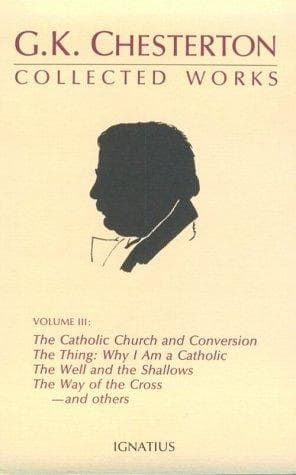
The Thing: Why I Am a Catholic
الشيء: لماذا أنا كاثوليكي
La Chose : Pourquoi je suis Catholique
Editorial summary
This essay collection presents Chesterton's defense of Catholic Christianity through a characteristically paradoxical lens, arguing that the Church's apparent contradictions and complexities constitute evidence for its divine origin rather than grounds for skepticism. Writing in response to modernist critiques of religion prevalent in early twentieth-century Britain, Chesterton develops a theological epistemology that inverts conventional rational objections to faith.
The work's central argument posits that Christianity's intellectual difficulty and moral demands authenticate its supernatural character. Where critics like H.G. Wells and Bernard Shaw dismissed Catholic doctrine as an incoherent accumulation of superstitions, Chesterton contends that only a divinely instituted religion could maintain such seemingly impossible tensions—between justice and mercy, asceticism and celebration, universality and particularity—without dissolution into simpler, more humanly manageable forms. He employs the metaphor of a key's complexity matching a lock's intricacy to suggest that Christianity's elaborate theological architecture corresponds precisely to the complexity of human existence and cosmic reality.
Methodologically, Chesterton proceeds through dialectical reversals of secular assumptions. He argues that modern philosophies fail precisely because they are too simple and consistent, while Catholic theology succeeds through its embrace of paradox. The collection engages extensively with contemporary materialism, examining how reductive naturalistic explanations cannot account for consciousness, moral experience, or aesthetic perception. Against evolutionary naturalism, Chesterton proposes that human reason's ability to transcend material conditions points toward a transcendent source.
The essays develop a distinctive natural theology that finds evidence for God not in philosophical proofs but in the fittingness between Catholic doctrine and lived experience. Chesterton argues that the Church's survival through historical vicissitudes, its production of saints alongside sinners, and its simultaneous appeals to peasants and philosophers indicate supernatural guidance. He particularly emphasizes how Catholic sacramentalism affirms material creation while acknowledging spiritual reality, avoiding both materialist reductionism and gnostic escapism.
This work significantly influenced twentieth-century Catholic apologetics, particularly through its strategy of accepting modernity's criticisms while demonstrating their insufficiency. Chesterton's approach anticipates later developments in Reformed epistemology and narrative theology, showing how religious belief might be rationally justified without conforming to Enlightenment standards of demonstration. His integration of aesthetic, moral, and intellectual arguments provides a holistic vision of faith that continues to shape contemporary theological discourse.
Argument formulations engaged
Related works
Chesterton, G. K. (1929). The Thing: Why I Am a Catholic. Sheed & Ward.
@book{the-thing-why-i-am-a-catholic-1929,
  author    = {Chesterton, G. K.},
  title     = {The Thing: Why I Am a Catholic},
  year      = {1929},
  publisher = {Sheed & Ward},
  url       = {https://god-database.com/en/works/the-thing-why-i-am-a-catholic-1929}
}