
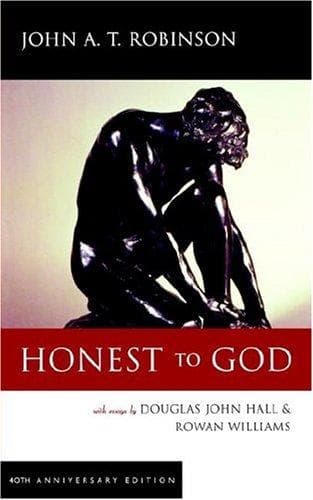
Honest to God
صادق مع الله
Honnête envers Dieu
Editorial summary
John A. T. Robinson's Honest to God represents a watershed moment in twentieth-century theology, challenging traditional Christian conceptualizations of God and calling for a radical reconstruction of belief suited to the modern world. Writing as Anglican Bishop of Woolwich, Robinson synthesizes insights from Paul Tillich, Dietrich Bonhoeffer, and Rudolf Bultmann to argue that conventional theistic imagery has become increasingly untenable for contemporary believers.
The work's central thesis contends that traditional representations of God as a supernatural being "up there" or "out there" no longer resonate with modern consciousness and actually impede genuine faith. Drawing heavily on Tillich's concept of God as "the ground of being," Robinson proposes replacing spatial metaphors with existential depth. He argues that God should be understood not as a separate entity existing alongside the world, but as the ultimate reality encountered in the depths of personal existence and authentic human relationships.
Robinson employs Bonhoeffer's notion of "religionless Christianity" to critique institutional religion's tendency to compartmentalize the sacred from secular life. He advocates for a worldly holiness that finds God not in religious observances but in full engagement with contemporary existence. This approach challenges both conservative supernaturalism and liberal attempts to preserve traditional God-language while evacuating it of literal meaning.
The work's methodology combines pastoral concern with philosophical analysis, drawing on existentialist thought to reinterpret Christian doctrine. Robinson examines prayer, ethics, and Christology through this lens, arguing that authentic spirituality emerges through radical openness to others rather than through traditional religious practices. His treatment of Jesus emphasizes the "man for others" who reveals God precisely through his complete humanity.
The book's significance lies in its articulation of a theological crisis that many mid-twentieth-century Christians experienced but struggled to express. Robinson's willingness to voice doubts about traditional formulations while maintaining Christian commitment opened space for theological reconstruction. Critics from conservative quarters accused him of atheism, while secular thinkers questioned whether his position remained meaningfully theistic. These debates highlight the work's provocative nature and its challenge to established categories.
Honest to God matters for the God debate because it demonstrates how classical theism's perceived inadequacies can motivate theological innovation rather than abandonment of religious belief. Robinson's project exemplifies the attempt to preserve religious meaning while acknowledging modern intellectual and cultural challenges to traditional God-concepts.
Argument formulations engaged
Related works
Robinson, John A. T. (1963). Honest to God. Philadelphia, Westminster Press.
@book{honest-to-god-1963,
  author    = {Robinson, John A. T.},
  title     = {Honest to God},
  year      = {1963},
  publisher = {Philadelphia, Westminster Press},
  url       = {https://god-database.com/en/works/honest-to-god-1963}
}