
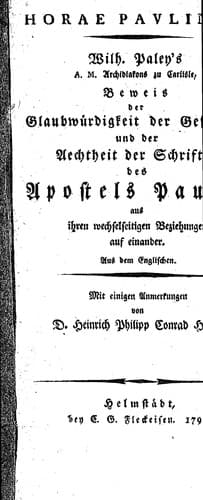
Horae Paulinae
الساعات البولسية
Editorial summary
Paley's Horae Paulinae represents a pioneering work in historical apologetics, employing a method of textual analysis that seeks to demonstrate the authenticity and reliability of the New Testament through the examination of undesigned coincidences between the Pauline epistles and the Acts of the Apostles. Published in 1790, this monograph emerged during the Enlightenment period when rational criticism increasingly challenged traditional religious authority, and Paley responds by applying empirical methods to defend Christian scripture.
The work's central argument rests on the identification of numerous subtle correspondences between Paul's letters and Luke's narrative in Acts—correspondences that appear neither contrived nor deliberately harmonized. Paley contends that these incidental agreements, which often concern minor details of geography, chronology, or personal circumstances, could only result from independent authors recording genuine historical events. He systematically examines each Pauline epistle, comparing internal evidence with the Acts narrative to reveal what he terms "undesigned coincidences"—details that corroborate each other without apparent intention.
Paley's methodology anticipates later developments in historical criticism while maintaining an apologetic purpose. Against deist critics who questioned biblical reliability and miracle claims, he argues that the very subtlety of these correspondences precludes forgery or later fabrication. The work implicitly challenges Hume's skepticism about testimony and miracles by suggesting that the convergent evidence of multiple independent sources establishes a probability approaching certainty. Unlike his later Natural Theology, which argues from design in nature, Horae Paulinae grounds its case in documentary evidence and historical reasoning.
The significance of this work extends beyond its immediate apologetic context. Paley's approach influenced subsequent biblical scholarship by demonstrating how careful textual comparison could yield historical insights. His method provided a model for defending religious texts through internal evidence rather than external authority, appealing to empirical investigation rather than dogmatic assertion. While modern biblical criticism has moved beyond Paley's conclusions, his technique of examining incidental details for historical verification remains influential. The work thus occupies an important position in the development of both biblical apologetics and critical methodology, representing an Enlightenment attempt to defend traditional faith through rational inquiry. Its lasting contribution lies in showing how detailed textual analysis might serve theological purposes while maintaining scholarly rigor.
Argument formulations engaged
Paley, William (1790). Horae Paulinae. R. Faulder.
@book{horae-paulinae-1790,
  author    = {Paley, William},
  title     = {Horae Paulinae},
  year      = {1790},
  publisher = {R. Faulder},
  url       = {https://god-database.com/en/works/horae-paulinae-1790}
}