
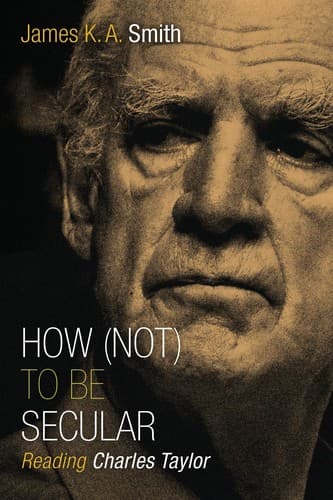
How (Not) to Be Secular
كيف (لا) تكون علمانياً
Comment (ne pas) être séculier
Editorial summary
This monograph offers a critical reading of Charles Taylor's A Secular Age, presenting Taylor's analysis of Western secularization while making it accessible to broader audiences. Smith examines how contemporary secular culture emerges not as a simple subtraction of belief but as a complex historical development creating new conditions for both belief and unbelief.
The work traces Taylor's genealogy of the secular, showing how the medieval enchanted cosmos gave way to the modern buffered self. Smith explicates Taylor's argument that secularization involves a fundamental shift in the social imaginary—the background assumptions that make certain beliefs seem plausible or implausible. This transformation creates what Taylor calls a "nova effect," an explosion of spiritual options beyond simple theism or atheism. Smith emphasizes how exclusive humanism becomes conceivable only through specific historical developments, not as humanity's natural state once religion is removed.
Central to Smith's exposition is Taylor's concept of "cross-pressure"—the simultaneous pull toward transcendence and immanence experienced by believers and unbelievers alike in secular societies. He shows how Taylor challenges both conventional secularization narratives and defensive religious accounts. The secular age is not one where belief disappears but where it becomes one option among many, no longer the default position. Smith highlights Taylor's critique of "subtraction stories" that present secularization as humanity minus superstition, revealing instead how new values and meanings emerge to fill perceived voids.
The book engages particularly with Taylor's analysis of art, literature, and everyday practices as sites where transcendence haunts secular life. Smith demonstrates how Taylor's phenomenology of lived experience reveals cracks in the immanent frame—moments when people sense something beyond the material world despite secular assumptions. This analysis proves especially relevant for understanding why exclusive humanism often feels inadequate even to its adherents.
Smith's contribution lies in translating Taylor's dense philosophical work for pastoral and practical application. He shows how Taylor's analysis helps religious communities understand their cultural moment without defensiveness or despair. The work provides tools for recognizing how secular and religious perspectives share common pressures and longings. By clarifying Taylor's argument that all positions in the contemporary West operate under conditions of secularity, Smith opens space for more thoughtful dialogue between belief and unbelief, moving beyond simplistic culture war narratives.
Argument formulations engaged
Related works
Smith, James K. A. (2014). How (Not) to Be Secular. Wm. B. Eerdmans Publishing Co.
@book{how-not-to-be-secular-2014,
  author    = {Smith, James K. A.},
  title     = {How (Not) to Be Secular},
  year      = {2014},
  publisher = {Wm. B. Eerdmans Publishing Co},
  url       = {https://god-database.com/en/works/how-not-to-be-secular-2014}
}