
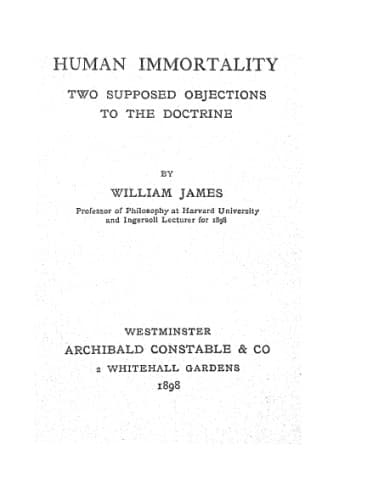
Human Immortality: Two Supposed Objections to the Doctrine
الخلود البشري: اعتراضان مفترضان على العقيدة
L'immortalité humaine : Deux objections supposées à la doctrine
Editorial summary
William James's "Human Immortality: Two Supposed Objections to the Doctrine" addresses scientific challenges to personal survival after death through a sophisticated philosophical defense of immortality's logical possibility. Written for the Ingersoll Lecture at Harvard in 1898, this work exemplifies James's characteristic pragmatism while engaging materialist critiques of religious belief during an era of increasing scientific naturalism.
James confronts two principal objections to immortality. The first concerns the apparent dependence of consciousness on brain function, which materialists interpret as proving that mental life cannot survive bodily death. James counters this through his "transmission theory," arguing that the brain might function not as the producer of consciousness but as its transmitter or permissive organ. Drawing an analogy with a prism refracting light, he suggests the brain could be channeling rather than creating consciousness. This model preserves the empirical correlation between brain states and mental phenomena while allowing for consciousness to persist independently of its material substrate.
The second objection involves the supposed incredibility of universal immortality given the vast number of human beings. Critics argue that extending immortality to all persons, regardless of worth or development, strains credulity. James responds by challenging anthropocentric assumptions about value and significance. He argues that from a divine perspective, every consciousness might possess inherent worth invisible to human judgment. This democratic vision of immortality reflects James's philosophical commitment to radical empiricism and individual experience.
The work demonstrates James's mediating position between traditional religious doctrine and scientific materialism. Rather than defending immortality through revealed theology or metaphysical proof, he establishes its compatibility with empirical evidence. His approach anticipates later developments in philosophy of mind, particularly debates about consciousness and physicalism. James explicitly engages contemporary physiologists and philosophers, including Eduard Pflüger and Gustav Fechner, situating his argument within late nineteenth century scientific discourse.
The monograph's significance extends beyond its specific arguments to exemplify a broader methodological approach. James shows how religious beliefs can be defended without abandoning scientific respectability, offering a model for constructive dialogue between faith and reason. His transmission theory provides conceptual resources for those seeking to maintain spiritual commitments while acknowledging neuroscience's findings. The work remains relevant for contemporary discussions about consciousness, personal identity, and the relationship between mental and physical phenomena.
Argument formulations engaged
Related works
James, William (1898). Human Immortality: Two Supposed Objections to the Doctrine. Houghton Mifflin.
@book{human-immortality-two-supposed-objection,
  author    = {James, William},
  title     = {Human Immortality: Two Supposed Objections to the Doctrine},
  year      = {1898},
  publisher = {Houghton Mifflin},
  url       = {https://god-database.com/en/works/human-immortality-two-supposed-objections-to-the-doctrine-1898}
}