
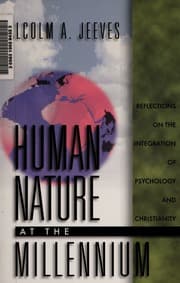
Human Nature at the Millennium
الطبيعة الإنسانية في الألفية
La nature humaine au millénaire
Editorial summary
This work explores the intersection of neuroscience, psychology, and Christian anthropology, examining how contemporary scientific understanding of human nature relates to traditional theological accounts. Jeeves addresses the perennial question of how divine action and human nature intersect, particularly in light of advances in brain science and cognitive psychology that appear to challenge dualistic conceptions of the person.
The monograph engages with the mind-brain problem as it bears on religious belief, investigating whether neuroscientific explanations of consciousness and behavior undermine or can be reconciled with theistic accounts of human beings as created in God's image. Jeeves examines the implications of neurological research for understanding religious experience, moral agency, and the soul. He critiques both reductive materialism and substance dualism, arguing for a non-reductive physicalist approach that maintains the reality of mental properties while acknowledging their dependence on neural processes.
Central to Jeeves's argument is the claim that scientific discoveries about human cognition need not threaten core Christian convictions about human nature, divine action, or moral responsibility. He contends that properly understood, neuroscience reveals the complexity of human beings without eliminating the possibility of divine-human interaction. The work addresses concerns that neurological explanations of religious experience reduce it to mere brain states, arguing instead for a multilevel understanding that preserves both scientific and theological insights.
The monograph engages with both scientific materialists who dismiss religious accounts of human nature and traditional dualists who resist integration with neuroscience. Jeeves draws on biblical scholarship to argue that scripture presents a holistic view of persons rather than a strict soul-body dualism, making his position more compatible with contemporary science than often assumed. He examines case studies from neuropsychology, including religious experience in temporal lobe epilepsy and the neural correlates of prayer and meditation.
This contribution matters to the God debate by demonstrating how a sophisticated understanding of neuroscience can coexist with theistic belief. Jeeves provides a model for how religious thinkers can engage seriously with scientific findings without abandoning theological commitments. His work challenges both the conflict thesis that science and religion are incompatible and simplistic harmonization attempts that ignore genuine tensions. By addressing specific neurological findings and their philosophical implications, the monograph offers resources for those seeking to maintain religious belief while accepting contemporary scientific understanding of human nature.
Argument formulations engaged
Jeeves, Malcolm (1997). Human Nature at the Millennium.
@book{human-nature-at-the-millennium-1997,
  author    = {Jeeves, Malcolm},
  title     = {Human Nature at the Millennium},
  year      = {1997},
  url       = {https://god-database.com/en/works/human-nature-at-the-millennium-1997}
}