
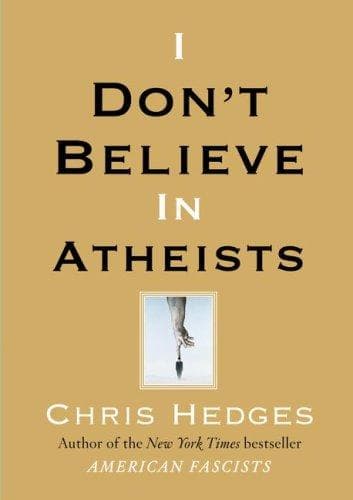
I don't believe in Atheists
لا أؤمن بالملحدين
Je ne crois pas aux athées
Chris Hedges argues that the 'New Atheists' — figures such as Sam Harris and Christopher Hitchens — are themselves a form of fundamentalism, replacing religious dogma with an equally dangerous secular utopianism that denies the complexity of human nature and the enduring necessity of myth.
Editorial summary
This provocative monograph challenges the intellectual coherence and practical viability of atheism through a sustained exercise in cultural criticism. The work's central thesis contends that consistent atheism, when examined closely, reveals itself as an untenable position that its adherents cannot genuinely maintain in practice. The author employs a methodological approach that combines philosophical analysis with sociological observation, scrutinizing both the theoretical foundations and lived expressions of contemporary atheistic thought.
The text engages primarily with moral argumentation, questioning whether atheism can provide adequate grounding for the ethical commitments that self-identified atheists typically espouse. The author argues that atheists inevitably smuggle in transcendent values and metaphysical assumptions that contradict their professed materialism, particularly when addressing questions of human dignity, moral obligation, and social justice. This critique extends beyond academic philosophy to examine how prominent atheist intellectuals navigate these contradictions in their public discourse and personal lives.
Drawing from the secular-naturalist tradition, the work operates from within a broadly naturalistic framework while remaining skeptical of reductive materialism. The author's critique of religion serves not to defend traditional theism but rather to demonstrate that contemporary atheism often functions as a quasi-religious system complete with its own orthodoxies, moral prescriptions, and unfounded certainties. This analysis reveals atheism as paradoxically dependent upon the very metaphysical categories it claims to reject.
The monograph's cultural criticism extends to examining the social and political dimensions of organized atheism, particularly the New Atheist movement prominent in 2008. The author argues that atheist communities exhibit religious-like behaviors including proselytization, moral absolutism, and group identity formation based on shared beliefs about ultimate reality. These observations support the work's contention that atheism as commonly practiced contradicts its own stated principles.
The work's significance lies in its challenge to both religious and irreligious certainties, suggesting that honest intellectual inquiry must acknowledge the irreducible complexity of human existence and the limits of purely naturalistic explanations. By demonstrating the internal tensions within atheistic thought, the author opens space for alternative approaches to questions of meaning, morality, and transcendence that move beyond the traditional theist-atheist binary. The monograph thus contributes to ongoing debates about the relationship between belief, knowledge, and human flourishing in secular societies.
Structured analysis
Argument formulations engaged
Related works
Hedges, Chris (2008). I don't believe in Atheists. Continuum International Publis.
@book{i-dont-believe-in-atheists,
  author    = {Hedges, Chris},
  title     = {I don't believe in Atheists},
  year      = {2008},
  publisher = {Continuum International Publis},
  url       = {https://god-database.com/en/works/i-dont-believe-in-atheists}
}