
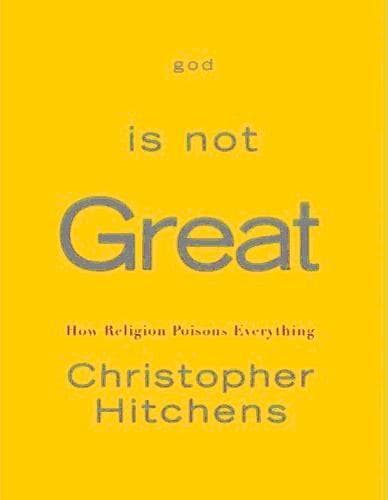
God Is Not Great
الله ليس عظيماً
Dieu n'est pas grand
Organized religion is not merely false but actively harmful, having poisoned morality, science, politics, and human solidarity throughout history, and its claims fail every rational and evidential test.
Editorial summary
Christopher Hitchens' God Is Not Great represents one of the most influential popular atheist works of the early twenty-first century, forming part of the "New Atheist" movement alongside texts by Richard Dawkins, Sam Harris, and Daniel Dennett. The work deploys a polemical-essay methodology to mount a comprehensive attack on religious belief, arguing not merely that religion is false but that it actively poisons human civilization.
Hitchens structures his critique around three primary argument families. First, he develops a version of the problem of evil that extends beyond traditional formulations to encompass the moral failings of religious institutions themselves. Rather than focusing solely on natural suffering or divine hiddenness, Hitchens catalogs historical and contemporary examples of religiously motivated violence, oppression, and intellectual stultification. This approach shifts the problem of evil from a logical puzzle about divine attributes to an empirical indictment of religion's real-world consequences.
Second, the work advances naturalistic explanations for religious phenomena, drawing on anthropology, psychology, and evolutionary theory to account for belief in the supernatural. Hitchens argues that religion emerges from primitive attempts to explain natural phenomena, psychological needs for comfort and meaning, and evolutionary pressures favoring group cohesion. This naturalistic framework seeks to explain away rather than explain religion, treating it as a comprehensible human construction rather than a response to genuine transcendent reality.
Third, Hitchens employs burden-of-proof arguments to challenge the epistemological foundations of religious belief. He contends that extraordinary claims require extraordinary evidence, and that religion consistently fails to meet this evidentiary standard. The work particularly targets faith-based epistemologies, arguing that belief without evidence or despite contrary evidence represents an intellectual and moral failing.
The text's significance lies partly in its accessibility and rhetorical force, bringing philosophical arguments against theism to a mass audience through vivid prose and memorable formulations. Hitchens' subtitle—"How Religion Poisons Everything"—encapsulates his totalizing critique. Unlike more measured philosophical treatments, the work refuses any accommodation with moderate or progressive religion, arguing that even benign forms of faith enable and protect more dangerous varieties. This uncompromising stance, combined with Hitchens' journalistic background and literary skill, helped catalyze public debate about atheism and secularism in ways that technical philosophical works rarely achieve.
Structured analysis
Argument formulations engaged
Related works
Hitchens, Christopher (2007). God Is Not Great.
@book{god-is-not-great-how-religion-poisons-ev,
  author    = {Hitchens, Christopher},
  title     = {God Is Not Great},
  year      = {2007},
  url       = {https://god-database.com/en/works/god-is-not-great-how-religion-poisons-everything}
}