
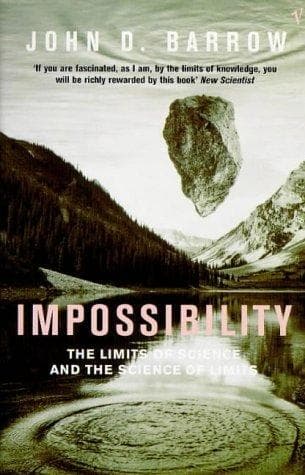
Impossibility.. The Limits of Science and the Science of Limits
الاستحالة.. حدود العلم وعلم الحدود
L'Impossibilité.. Les limites de la science et la science des limites
There exist fundamental limits to what science can know, compute, or achieve, and these limits are not mere practical obstacles but structural features of reality that any serious worldview must confront.
Editorial summary
This philosophical exploration of scientific limitations examines how the boundaries of human knowledge bear upon questions of ultimate reality and divine existence. Barrow, a theoretical physicist and mathematician, investigates the inherent constraints that prevent science from achieving complete knowledge of the universe, analyzing these limits through multiple lenses: mathematical, computational, observational, and conceptual.
The work engages substantially with cosmological questions that traditionally intersect with natural theology. Barrow examines how fundamental limits in physics—such as quantum uncertainty, computational irreducibility, and observational horizons—create permanent gaps in scientific knowledge. These limitations become philosophically significant when considering whether scientific explanation can ever be exhaustive or whether reality necessarily contains elements beyond empirical reach. The analysis connects these constraints to classical questions about first causes and ultimate explanations that feature prominently in cosmological arguments.
Regarding fine-tuning, Barrow explores how the apparent precision of physical constants necessary for complex structures raises interpretive questions that science alone cannot resolve. He examines various responses to cosmic fine-tuning, including multiverse hypotheses and anthropic principles, while maintaining that the choice between these explanations involves philosophical commitments extending beyond empirical data. The treatment avoids both naive scientism and anti-scientific sentiment, instead mapping the legitimate boundaries where scientific method meets its inherent limits.
The methodology draws from philosophy of science, particularly examining how Godel's incompleteness theorems, chaos theory, and quantum mechanics reveal principled restrictions on predictability and knowledge. Barrow situates these contemporary insights within broader epistemological traditions, showing how modern physics recapitulates certain classical philosophical puzzles about the knowability of reality while generating novel constraints unique to mathematical physics.
The work's significance lies in its rigorous demonstration that scientific materialism faces internal limitations rather than merely external challenges. By showing how science itself reveals its own boundaries, Barrow opens intellectual space for considering trans-empirical questions without abandoning scientific rationality. This approach proves particularly relevant for contemporary discussions where scientific authority often functions to dismiss metaphysical inquiry. The analysis suggests that recognizing science's limits need not diminish its achievements but rather clarifies the legitimate scope of different modes of human understanding, potentially including theological reflection on ultimate questions that necessarily exceed empirical investigation.
Structured analysis
Structure of the work
Argument formulations engaged
Barrow, John D. (2009). Impossibility.. The Limits of Science and the Science of Limits.
@book{impossibility-the-limits-of-science-and-,
  author    = {Barrow, John D.},
  title     = {Impossibility.. The Limits of Science and the Science of Limits},
  year      = {2009},
  url       = {https://god-database.com/en/works/impossibility-the-limits-of-science-and-the-science-of-limits}
}