
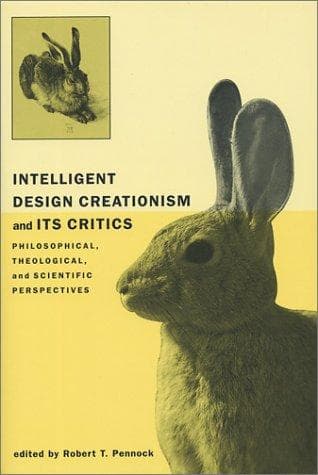
Intelligent Design Creationism and Its Critics
الخلقية بالتصميم الذكي ونقادها
Le créationnisme du dessein intelligent et ses critiques
Editorial summary
This comprehensive anthology assembles the central arguments in the intelligent design controversy, presenting both advocates and critics of the movement that emerged in the 1990s as a putative scientific alternative to evolutionary theory. Pennock structures the volume to illuminate the philosophical, scientific, and theological dimensions of intelligent design theory, particularly its claim that certain features of the natural world exhibit complexity that necessitates an intelligent cause rather than undirected natural processes.
The collection opens with foundational texts from intelligent design proponents, including Michael Behe's irreducible complexity argument and William Dembski's specified complexity criterion. These contributors argue that biological systems contain information-rich structures that cannot arise through gradual Darwinian mechanisms, thereby inferring design as the best explanation. The volume then presents systematic critiques from philosophers of science, biologists, and theologians who challenge these arguments on multiple fronts.
Critics in the volume demonstrate that intelligent design fails to meet the methodological standards of scientific inquiry, lacking testable predictions and explanatory power. Kenneth Miller and others show how purportedly irreducibly complex systems can evolve through standard evolutionary mechanisms. Philosophers like Elliott Sober examine the logical structure of design inferences, revealing fundamental flaws in how intelligent design theorists calculate probabilities and draw conclusions about causation.
The work proves particularly valuable for its inclusion of theological perspectives that reject intelligent design despite affirming theistic belief. Several contributors argue that intelligent design represents poor theology as well as poor science, conflating scientific explanation with metaphysical causation. This internal religious critique strengthens the volume's demonstration that opposition to intelligent design does not require atheistic commitments.
Pennock's editorial framework emphasizes that the intelligent design movement, despite its proponents' claims to religious neutrality, functions as a form of creationism seeking to introduce supernatural explanations into scientific discourse. The volume documents how intelligent design emerges from earlier creationist strategies while attempting to avoid explicit religious language to circumvent legal restrictions on teaching religion in public schools.
By bringing together primary sources from all sides, this anthology provides essential documentation of a significant episode in the contemporary religion-science dialogue. The work demonstrates how questions about biological complexity and information continue to animate debates about divine action, naturalism, and the boundaries of scientific explanation.
Argument formulations engaged
Related works
Pennock, Robert T. (2001). Intelligent Design Creationism and Its Critics.
@book{intelligent-design-creationism-and-its-c,
  author    = {Pennock, Robert T.},
  title     = {Intelligent Design Creationism and Its Critics},
  year      = {2001},
  url       = {https://god-database.com/en/works/intelligent-design-creationism-and-its-critics-2001}
}