
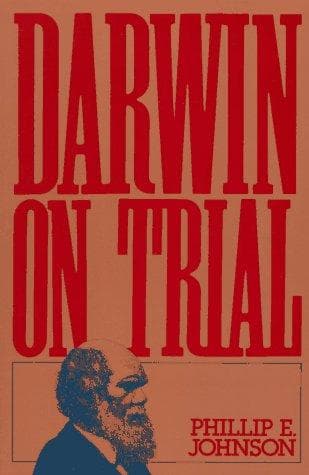
Darwin on Trial
داروين في قفص الاتهام
Darwin au tribunal
Darwinian evolution rests not on empirical evidence but on a prior commitment to philosophical naturalism, and when subjected to rigorous evidentiary scrutiny it fails as a scientific theory.
Editorial summary
Phillip E. Johnson's Darwin on Trial represents a pivotal intervention in late twentieth-century debates over evolution, naturalism, and theistic belief. A Berkeley law professor applying juridical methods to scientific claims, Johnson scrutinizes Darwinian evolution not primarily as biological theory but as ideological commitment to philosophical naturalism. His central contention holds that contemporary evolutionary biology rests on circular reasoning, where naturalistic assumptions predetermine conclusions that then purport to justify those same assumptions.
Johnson's prosecutorial approach examines the evidentiary basis for macroevolution, distinguishing between empirically demonstrable microevolutionary changes and the broader claims about life's origins and development. He argues that Darwinism functions as a creation myth for secular culture, maintained through institutional authority rather than compelling evidence. The work systematically challenges what Johnson identifies as the conflation of methodological naturalism with metaphysical naturalism in scientific practice, suggesting this confusion shields evolutionary theory from legitimate critique.
Engaging with prominent evolutionists including Stephen Jay Gould, Richard Dawkins, and Ernst Mayr, Johnson contends their arguments reveal philosophy masquerading as empirical science. He particularly targets the fossil record's discontinuities, the absence of observable speciation events, and the probabilistic difficulties in explaining complex biological systems through undirected processes. These critiques serve his broader project of reopening intellectual space for design arguments previously dismissed as unscientific.
The monograph's significance extends beyond specific biological disputes to fundamental questions about knowledge, authority, and permissible explanations in public discourse. Johnson challenges the epistemic monopoly claimed by naturalistic science, arguing that excluding design hypotheses a priori represents philosophical bias rather than methodological rigor. His work catalyzed the Intelligent Design movement, though Johnson himself focuses more on critiquing naturalism than developing positive design arguments.
Johnson's synthesis of legal reasoning with scientific criticism offers a distinctive apologetic strategy, treating Darwinism as a defendant requiring proof beyond reasonable doubt. While critics dismiss his approach as misunderstanding scientific methodology, supporters view it as exposing hidden assumptions in supposedly neutral scientific claims. The work's lasting influence lies in legitimizing public intellectual challenge to evolutionary orthodoxy and reframing the creation-evolution debate in terms of competing philosophical frameworks rather than science versus religion.
Structured analysis
Argument formulations engaged
Related works
Johnson, Phillip E. (1993). Darwin on Trial.
@book{darwin-on-trial,
  author    = {Johnson, Phillip E.},
  title     = {Darwin on Trial},
  year      = {1993},
  url       = {https://god-database.com/en/works/darwin-on-trial}
}