
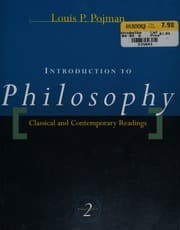
Introduction to Philosophy: Classical and Contemporary Readings
مقدمة في الفلسفة: قراءات كلاسيكية ومعاصرة
Introduction à la philosophie : Lectures classiques et contemporaines
Editorial summary
This comprehensive anthology assembles pivotal texts addressing fundamental philosophical questions, including substantial engagement with arguments concerning the existence and nature of God. Pojman structures the volume to trace philosophical inquiry from ancient origins through contemporary debates, positioning theistic questions as central to the Western philosophical tradition rather than peripheral concerns. The collection demonstrates how arguments about divine existence intersect with epistemology, metaphysics, ethics, and philosophy of mind.
The editor's selections reveal the evolution of theistic argumentation across historical periods. Classical texts include Platonic discussions of divine forms, Aristotelian arguments for an unmoved mover, and medieval synthesis through Anselm's ontological argument and Aquinas's five ways. These foundational pieces establish the rational framework within which subsequent God debates unfold. Pojman balances these with modern critiques, including Humean skepticism about miracles and design arguments, Kantian limitations on reason's capacity to prove divine existence, and Kierkegaardian emphasis on faith's irreducibility to rational demonstration.
Contemporary selections address twentieth-century developments in philosophy of religion. The volume includes analytic philosophers' reformulations of classical arguments, evidentialist challenges to religious belief, and Reformed epistemology's defense of belief without evidence. Pojman incorporates discussions of the problem of evil, presenting both theistic defenses and atheistic arguments that evil's existence undermines belief in an omnipotent, benevolent deity. The anthology also features debates about religious language, examining whether theological statements possess cognitive content or serve non-descriptive functions.
Pojman's editorial framework emphasizes dialogue between positions rather than advocating particular conclusions. Introductory materials contextualize each selection within broader philosophical movements and highlight connections between theistic questions and other philosophical domains. The volume demonstrates how God debates involve fundamental issues about knowledge, reality, morality, and human nature. By presenting opposing viewpoints on divine existence, the collection serves pedagogical purposes while illustrating philosophy's ongoing engagement with religious questions.
This anthology's significance lies in its presentation of theistic philosophy as intellectually rigorous discourse rather than mere faith assertion. Pojman's selections show how philosophers across traditions employ logical argumentation, conceptual analysis, and evidential reasoning when addressing God's existence. The volume thus counters both naive fideism and dismissive secularism, presenting the God question as deserving sustained philosophical attention. Through careful curation of texts spanning 2500 years, Pojman demonstrates that debates about divine existence remain philosophically vital rather than historically obsolete.
Argument formulations engaged
Pojman, Louis P. (1991). Introduction to Philosophy: Classical and Contemporary Readings. Oxford University Press.
@book{introduction-to-philosophy-classical-and,
  author    = {Pojman, Louis P.},
  title     = {Introduction to Philosophy: Classical and Contemporary Readings},
  year      = {1991},
  publisher = {Oxford University Press},
  url       = {https://god-database.com/en/works/introduction-to-philosophy-classical-and-contemporary-readings-1991}
}