
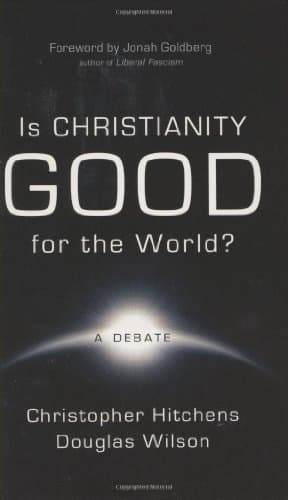
Is Christianity Good for the World?
هل المسيحية مفيدة للعالم؟
Le christianisme est-il bon pour le monde ?
Editorial summary
This provocative work stages a written debate between Christopher Hitchens, the renowned atheist polemicist, and Douglas Wilson, a Reformed theologian. The book addresses the fundamental question of whether Christianity constitutes a net positive or negative force in human affairs, with each author defending their position through a series of exchanges originally published in Christianity Today magazine.
Hitchens deploys his characteristic rhetorical arsenal against religious belief, arguing that Christianity represents not merely a false worldview but an actively harmful influence on human civilization. He contends that religious faith corrupts moral reasoning by grounding ethics in divine command rather than human welfare, thereby licensing atrocities throughout history. Drawing on historical examples from the Crusades to contemporary religious conflicts, Hitchens maintains that Christianity's truth claims lack evidential support while its moral claims prove demonstrably destructive. He particularly attacks the doctrine of vicarious redemption through Christ's sacrifice as both logically incoherent and morally repugnant, encouraging believers to abdicate personal responsibility.
Wilson counters by arguing that atheistic materialism cannot ground objective moral values or human dignity. He contends that Hitchens borrows moral capital from the very Christian worldview he rejects, as concepts like human rights and universal dignity emerge from biblical anthropology rather than evolutionary naturalism. Wilson addresses historical atrocities committed in Christianity's name by distinguishing authentic Christian teaching from its corruptions, while highlighting the humanitarian achievements of Christian civilization in education, healthcare, and social reform.
The debate's significance lies partly in its format, which allows sustained engagement between opposing worldviews rather than parallel monologues. Both authors display considerable erudition and rhetorical skill, though their arguments often proceed from incommensurable premises. Hitchens emphasizes empirical evidence and consequentialist ethics, while Wilson operates within a presuppositionalist framework that views all reasoning as necessarily grounded in unprovable axioms.
This exchange exemplifies the New Atheism movement's confrontational approach to religious critique while simultaneously revealing the philosophical complexities underlying apparently straightforward questions about religion's social utility. The work demonstrates how debates about Christianity's worldly effects inevitably invoke deeper disagreements about epistemology, moral foundations, and the nature of human flourishing. Its lasting contribution consists in modeling substantive intellectual engagement across worldview divides while illuminating why such debates often reach philosophical impasse.
Argument formulations engaged
Related works
Hitchens, Christopher (2008). Is Christianity Good for the World?. Canon Press.
@book{is-christianity-good-for-the-world-2008,
  author    = {Hitchens, Christopher},
  title     = {Is Christianity Good for the World?},
  year      = {2008},
  publisher = {Canon Press},
  url       = {https://god-database.com/en/works/is-christianity-good-for-the-world-2008}
}