
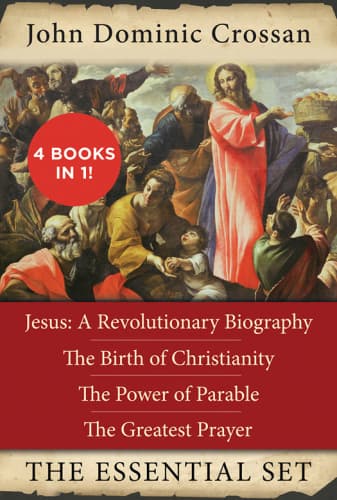
Jesus: A Revolutionary Biography
يسوع: سيرة ثورية
Jésus : Une biographie révolutionnaire
Editorial summary
This provocative historical reconstruction challenges traditional Christian narratives by presenting Jesus as a Jewish peasant revolutionary rather than a divine figure. Crossan employs interdisciplinary methods combining anthropology, sociology, and comparative religion to situate Jesus within first-century Mediterranean society. His approach privileges the earliest textual strata, particularly Q and the Gospel of Thomas, while treating canonical gospels as later theological elaborations.
Central to Crossan's thesis is the distinction between the historical Jesus and the Christ of faith. He argues that Jesus operated as a wisdom teacher and social radical who challenged hierarchical structures through open commensality and radical egalitarianism. The kingdom of God, in this reading, represents not a future apocalyptic event but a present social program of economic and political transformation. Crossan portrays Jesus as advocating direct access to God without mediating institutions, thereby threatening both Jewish religious authorities and Roman imperial order.
The work systematically deconstructs supernatural elements in gospel narratives. Crossan interprets miracle stories as metaphorical expressions of social healing and transformation rather than literal events. The resurrection becomes a spiritual experience of continuing presence rather than physical resuscitation. He traces how early Christian communities transformed a failed messianic movement into a successful mystery religion by reinterpreting Jesus's execution as salvific.
Methodologically, Crossan applies cross-cultural anthropological models to ancient texts, drawing parallels between Jesus and other peasant leaders in agrarian societies. His stratification of sources reflects the Jesus Seminar's historical-critical approach, though he pushes beyond their consensus on several points. He engages critically with both conservative scholars who defend gospel historicity and liberal theologians who spiritualize Jesus's message while ignoring its political dimensions.
The work's significance lies in its comprehensive naturalistic explanation of Christian origins. By grounding Jesus entirely within historical and social forces, Crossan implicitly argues against divine intervention in human affairs. His reconstruction serves those seeking to separate ethical teachings from theological claims, though it challenges believers who consider supernatural elements essential to Christian faith. The biography demonstrates how historical methodology can radically reframe religious narratives, offering a Jesus compatible with secular worldviews while potentially undermining traditional theistic interpretations. This tension between historical reconstruction and faith commitments remains central to contemporary debates about religious truth claims.
Argument formulations engaged
Related works
Crossan, John Dominic (1994). Jesus: A Revolutionary Biography. HarperCollins.
@book{jesus-a-revolutionary-biography-1994,
  author    = {Crossan, John Dominic},
  title     = {Jesus: A Revolutionary Biography},
  year      = {1994},
  publisher = {HarperCollins},
  url       = {https://god-database.com/en/works/jesus-a-revolutionary-biography-1994}
}