
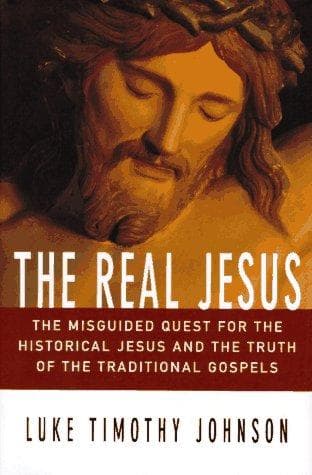
The Real Jesus
يسوع الحقيقي
Le Vrai Jésus
Editorial summary
This work presents a methodological critique of the Jesus Seminar and similar historical-critical approaches to reconstructing the life of Jesus. Johnson argues that these attempts to recover the "historical Jesus" through purely empirical methods fundamentally misunderstand both the nature of historical knowledge and the character of religious texts. He contends that the gospels were never intended as neutral historical records but rather as theological testimonies written by communities of faith to express their experience of the risen Christ.
Johnson's central thesis challenges the assumption that stripping away theological interpretation will reveal a more authentic Jesus. He maintains that this approach, exemplified by the Jesus Seminar's voting procedures and color-coding of gospel sayings, represents a form of methodological positivism that cannot adequately address the complexity of religious phenomena. The author argues that such reconstructions inevitably reflect contemporary cultural preferences rather than historical reality, producing a Jesus who conveniently aligns with modern liberal sensibilities.
The work engages directly with scholars like John Dominic Crossan, Burton Mack, and Marcus Borg, critiquing their portrayals of Jesus as a wisdom teacher or social revolutionary divorced from apocalyptic expectations and claims to divine authority. Johnson contends that these scholars selectively use sources, privileging hypothetical documents like Q and the Gospel of Thomas while dismissing the canonical gospels' unified witness to Jesus as the Christ. He argues this approach fails to account for the explosive growth of early Christianity, which cannot be explained by devotion to a mere teacher of aphorisms.
Johnson's alternative proposal emphasizes the "real Jesus" as the one encountered through faith and experienced in Christian community. He argues that historical criticism, while valuable for understanding context, cannot access the full reality of Jesus because it excludes by definition the resurrection and ongoing spiritual presence that Christians claim as central to his identity. This position does not reject historical inquiry but insists on its limitations when applied to transcendent claims.
The work's significance lies in its challenge to the scholarly consensus that historical-critical methods provide privileged access to religious truth. Johnson argues for a more holistic approach that takes seriously the faith perspective of the texts themselves while maintaining intellectual rigor. His critique raises important questions about the relationship between historical investigation and religious belief, and whether attempts to separate the Jesus of history from the Christ of faith ultimately distort both.
Argument formulations engaged
Related works
Johnson, Luke Timothy (1996). The Real Jesus.
@book{the-real-jesus-1996,
  author    = {Johnson, Luke Timothy},
  title     = {The Real Jesus},
  year      = {1996},
  url       = {https://god-database.com/en/works/the-real-jesus-1996}
}