
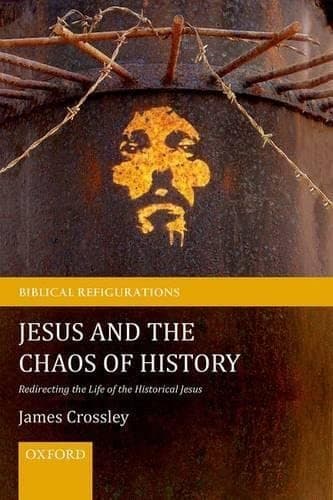
Jesus and the Chaos of History
يسوع وفوضى التاريخ
Jésus et le chaos de l'histoire
Editorial summary
This monograph presents a materialist reading of the historical Jesus that challenges both traditional Christian interpretations and secular liberal reconstructions of early Christianity. Crossley employs Marxist historiographical methods to situate Jesus within the socioeconomic upheavals of first-century Palestine, arguing that apocalyptic movements emerged as responses to Roman imperialism and economic exploitation rather than from purely religious motivations.
The work systematically deconstructs what Crossley identifies as the bourgeois assumptions underlying much historical Jesus scholarship. He contends that both conservative evangelical and liberal historical-critical approaches share an ideological investment in presenting Jesus as a unique religious innovator divorced from material conditions. Against this tendency, Crossley reads the Jesus movement through the lens of peasant resistance movements, interpreting apocalyptic language as coded political discourse rather than supernatural prophecy.
Central to Crossley's argument is the claim that early Christianity's rapid spread resulted not from divine intervention or Jesus's exceptional charisma, but from its articulation of anti-imperial sentiment among colonized populations. He analyzes parables and healing narratives as expressions of class conflict, presenting the kingdom of God as an essentially political concept representing liberation from economic oppression. This interpretation directly challenges theological readings that spiritualize Jesus's message.
The monograph engages critically with the third quest for the historical Jesus, particularly targeting scholars who minimize the political dimensions of Jesus's ministry. Crossley argues that depoliticized portraits of Jesus serve contemporary ideological functions, making Christianity palatable to modern capitalist societies. He demonstrates how seemingly neutral historical methods often encode theological assumptions about divine action in history.
Methodologically, Crossley combines social-scientific criticism with ideological critique, drawing on Antonio Gramsci's theories of hegemony and E.P. Thompson's history from below. This approach yields a Jesus who appears less as a religious reformer than as an organic intellectual of the peasant class. The work's significance lies in its systematic application of historical materialism to New Testament studies, offering a thoroughgoing naturalistic account of Christian origins that explains religious phenomena entirely through social and economic forces. By eliminating supernatural explanations while maintaining rigorous historical analysis, Crossley provides a compelling alternative to both confessional and liberal approaches to early Christianity.
Argument formulations engaged
Related works
Crossley, James (2015). Jesus and the Chaos of History. Oxford University Press.
@book{jesus-and-the-chaos-of-history-2015,
  author    = {Crossley, James},
  title     = {Jesus and the Chaos of History},
  year      = {2015},
  publisher = {Oxford University Press},
  url       = {https://god-database.com/en/works/jesus-and-the-chaos-of-history-2015}
}