
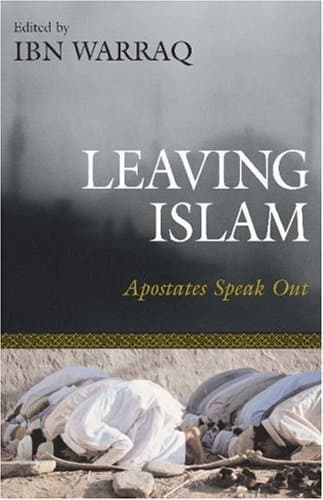
Leaving Islam: Apostates Speak Out
ترك الإسلام: المرتدون يتكلمون
Quitter l'islam : Les apostats témoignent
Editorial summary
This edited volume presents firsthand testimonies from individuals who have renounced Islam, offering a rare window into the psychological, social, and intellectual dimensions of religious apostasy. Ibn Warraq, himself a former Muslim, compiles accounts that range from philosophical critiques of Islamic theology to personal narratives of disillusionment and liberation. The work functions simultaneously as documentary evidence, political intervention, and implicit argument about the nature of religious belief itself.
The contributors articulate diverse pathways to apostasy, though certain patterns emerge. Many describe an initial period of cognitive dissonance between Islamic teachings and empirical observation or moral intuition. Several cite the problem of theodicy, questioning how an omnipotent and benevolent Allah could permit suffering or command violence. Others focus on epistemological concerns, finding the Quranic account of reality incompatible with scientific knowledge. The tension between divine determinism and human agency features prominently, as does criticism of Islam's treatment of women and non-believers.
Ibn Warraq positions these testimonies within broader debates about religious freedom and the possibility of Islamic reform. The volume implicitly challenges both Western multiculturalists who minimize criticism of Islam and Muslim apologists who deny the existence of voluntary apostasy. By presenting apostates as rational agents rather than victims of Western influence or psychological dysfunction, the work contests Islamic theological claims about the self-evident truth of revelation and the unnatural character of disbelief.
The methodological approach combines elements of oral history, phenomenology of religion, and advocacy journalism. While critics might question the representativeness of these accounts or their political instrumentalization, the volume provides crucial empirical data about lived experiences typically suppressed in Muslim-majority societies. The testimonies reveal how deconversion involves not merely intellectual rejection of propositions but profound identity transformation and social rupture.
For the philosophy of religion, this work contributes to understanding how individuals navigate exit from totalizing belief systems. The apostates' accounts suggest that religious adherence depends on complex interactions between communal pressure, emotional attachment, and cognitive conviction. Their experiences of liberation upon leaving Islam raise questions about whether certain religious frameworks inherently constrain human flourishing. The volume thus offers both a critique of Islamic theism and broader insights into the psychology of belief and unbelief.
Argument formulations engaged
Related works
Ibn Warraq (2003). Leaving Islam: Apostates Speak Out. Prometheus Books.
@book{leaving-islam-apostates-speak-out-2003,
  author    = {Ibn Warraq},
  title     = {Leaving Islam: Apostates Speak Out},
  year      = {2003},
  publisher = {Prometheus Books},
  url       = {https://god-database.com/en/works/leaving-islam-apostates-speak-out-2003}
}