
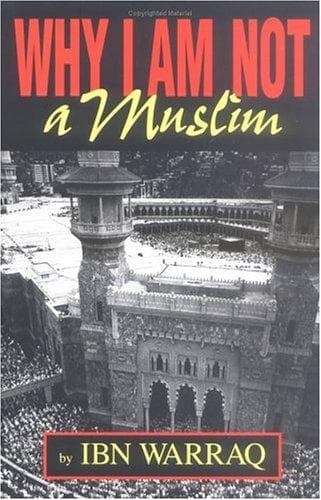
Why I Am Not a Muslim
لماذا لستُ مسلماً
Pourquoi je ne suis pas musulman
Islam, examined critically through its historical origins, textual sources, and political legacy, cannot withstand rational scrutiny and should be rejected as a foundation for individual or collective life.
Editorial summary
Ibn Warraq's Why I Am Not a Muslim represents a comprehensive critique of Islam from an apostate's perspective, employing intellectual-historical analysis to challenge the religion's foundational claims and contemporary manifestations. The work, whose title deliberately echoes Bertrand Russell's Why I Am Not a Christian, examines Islam through multiple critical lenses, focusing particularly on prophetic authority and theodicy.
The author systematically deconstructs Islamic origins, subjecting the Quran and hadith literature to historical-critical scrutiny typically reserved for Biblical texts in Western scholarship. Ibn Warraq questions the historical reliability of Islamic sources, arguing that the traditional narrative of Muhammad's life and the Quran's compilation cannot withstand rigorous historical examination. He draws extensively on the work of revisionist scholars like John Wansbrough and Patricia Crone, whose theories about Islam's late crystallization challenge orthodox Muslim historiography.
Central to the work is a sustained critique of Muhammad's prophetic claims. Ibn Warraq examines inconsistencies in Quranic revelation, alleged borrowings from Jewish and Christian sources, and what he considers morally problematic aspects of Muhammad's biography as recorded in Islamic tradition. This analysis directly engages classical prophecy arguments, inverting traditional Islamic apologetics that cite Muhammad's illiteracy and the Quran's literary excellence as proof of divine origin.
The problem of evil receives significant attention, particularly regarding Islamic theodicy and predestination doctrines. Ibn Warraq argues that Islam's emphasis on divine omnipotence creates insurmountable logical problems when confronted with human suffering and moral evil. He extends this critique to Islamic law, contending that sharia's prescriptions regarding women, religious minorities, and apostates reflect not divine wisdom but seventh-century Arabian social norms.
The work's significance lies in its rare perspective as an insider critique of Islam written for Western audiences. Published amid growing Western interest in Islamic fundamentalism, it provides a systematic deconstruction of Islamic truth claims from someone culturally fluent in the tradition. While controversial for its polemical tone, the book contributes to debates about religious criticism, apostasy, and the application of Enlightenment rationalism to non-Western religious traditions. Ibn Warraq's work thus occupies a unique position in contemporary discussions about Islam, secularism, and the limits of religious tolerance in pluralistic societies.
Structured analysis
Structure of the work
Argument formulations engaged
Related works
Ibn Warraq (1995). Why I Am Not a Muslim. Prometheus Books - A.
@book{why-i-am-not-a-muslim,
  author    = {Ibn Warraq},
  title     = {Why I Am Not a Muslim},
  year      = {1995},
  publisher = {Prometheus Books - A},
  url       = {https://god-database.com/en/works/why-i-am-not-a-muslim}
}