
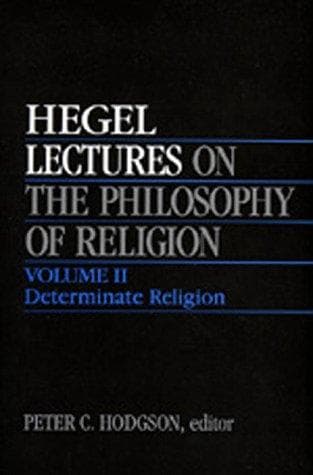
Lectures on the Philosophy of Religion
محاضرات في فلسفة الدين
Leçons sur la philosophie de la religion
Editorial summary
This monumental work represents Hegel's systematic attempt to comprehend religion through the lens of absolute idealism, positioning religious consciousness as a crucial moment in Spirit's self-realization. The lectures, delivered in Berlin between 1821 and 1831, demonstrate how religion expresses absolute truth through representation (Vorstellung) rather than pure conceptual thought, making it accessible to all humanity while philosophy reserves the same content for speculative reason.
Hegel structures his analysis in three parts: the concept of religion, determinate religion, and absolute religion. In examining religion's essence, he argues that religious consciousness involves the finite spirit's elevation to the infinite, a movement that overcomes the subject-object dichotomy characteristic of ordinary consciousness. This dialectical process reveals religion as humanity's consciousness of God, which simultaneously constitutes God's self-consciousness through human awareness.
The treatment of determinate religions follows a developmental schema, tracing humanity's religious evolution from nature religions through Greek and Roman polytheism to Judaism. Each stage represents a necessary moment in Spirit's progressive self-manifestation, with earlier forms containing truth that becomes more adequately expressed in subsequent developments. Hegel's controversial hierarchical ordering reflects his conviction that religions can be rationally evaluated according to their conceptual adequacy in expressing the absolute.
Christianity emerges as "absolute religion" because it perfectly embodies the unity of divine and human nature through the Incarnation. The Trinity provides the supreme religious representation of the dialectical structure of reality itself: God's self-differentiation and return to unity. Hegel transforms traditional Christian dogmas into philosophical categories, arguing that religious imagery conveys speculative truths about the nature of Spirit, though in pictorial rather than conceptual form.
The work's significance lies in its radical reconceptualization of the relationship between philosophy and religion. Against Enlightenment dismissals of religion as primitive superstition and romantic celebrations of religious feeling, Hegel presents religion as reason's legitimate expression in representational form. His system profoundly influenced subsequent philosophy of religion, from Feuerbach's anthropological critique to Kierkegaard's existential response. The lectures remain central to debates about religion's rational defensibility, the relationship between religious diversity and truth, and whether philosophical comprehension preserves or dissolves religious meaning. Hegel's speculative approach challenges both traditional theism and secular reductionism, proposing instead that genuine philosophical thinking culminates in a rational comprehension of the divine that preserves religion's essential insights while transcending its limitations.
Argument formulations engaged
Related works
Hegel, Georg Wilhelm Friedrich (1832). Lectures on the Philosophy of Religion.
@book{lectures-on-the-philosophy-of-religion-1,
  author    = {Hegel, Georg Wilhelm Friedrich},
  title     = {Lectures on the Philosophy of Religion},
  year      = {1832},
  url       = {https://god-database.com/en/works/lectures-on-the-philosophy-of-religion-1832}
}