
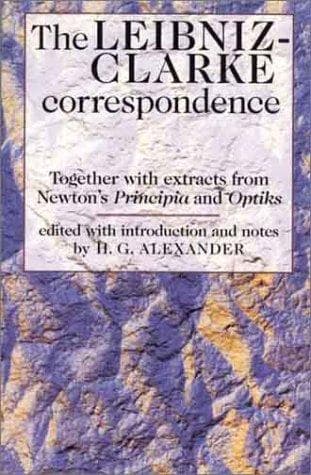
Leibniz-Clarke Correspondence
مراسلات لايبنيز-كلارك
Correspondance Leibniz-Clarke
Editorial summary
The Leibniz-Clarke Correspondence represents a pivotal exchange in early modern philosophy concerning the nature of God, space, time, and divine action in the world. Conducted between Gottfried Wilhelm Leibniz and Samuel Clarke from 1715 to 1716, this epistolary debate emerged from Leibniz's critique of Newtonian physics and its theological implications. Clarke, serving as Newton's philosophical spokesman, defends a voluntarist conception of God against Leibniz's rationalist alternative.
Central to the correspondence is the question of how God relates to the physical universe. Clarke maintains that absolute space and time exist as God's sensorium—the medium through which the divine perceives and acts upon creation. This view supports a God who intervenes directly in natural processes, occasionally adjusting the cosmic mechanism. Leibniz vigorously opposes this conception, arguing that it diminishes divine perfection by suggesting God created an imperfect world requiring constant maintenance. For Leibniz, God's wisdom and power manifest in creating a universe operating according to pre-established harmony, where divine providence works through natural laws rather than miraculous interventions.
The debate illuminates fundamental tensions in natural theology. Leibniz employs his principle of sufficient reason to argue that God acts only for the best reasons, making divine choice rational rather than arbitrary. Clarke counters that this threatens divine freedom, reducing God to a necessary being bound by reasons. Their disagreement extends to spatial metaphysics: while Clarke's Newtonian position requires absolute space as the arena for divine action, Leibniz's relational view of space coheres with his vision of God working through the internal principles of substances rather than external manipulation.
The correspondence demonstrates how emerging scientific worldviews shaped theological discourse. Newton's mechanics seemed to require continuous divine intervention to maintain planetary orbits, which Clarke embraces as evidence of God's active providence. Leibniz sees this as philosophically and theologically problematic, preferring a God whose perfection appears in the self-sufficiency of creation. This exchange profoundly influenced subsequent discussions about divine action, natural laws, and the relationship between science and theology. The debate's sophistication shows how technical philosophical arguments about space, time, and causation directly impact conceptions of divine nature and action, establishing frameworks that continue to inform contemporary discussions in philosophy of religion and science-theology dialogue.
Argument formulations engaged
Related works
Leibniz, G. W. (1717). Leibniz-Clarke Correspondence.
@book{leibniz-clarke-correspondence-1717,
  author    = {Leibniz, G. W.},
  title     = {Leibniz-Clarke Correspondence},
  year      = {1717},
  url       = {https://god-database.com/en/works/leibniz-clarke-correspondence-1717}
}