
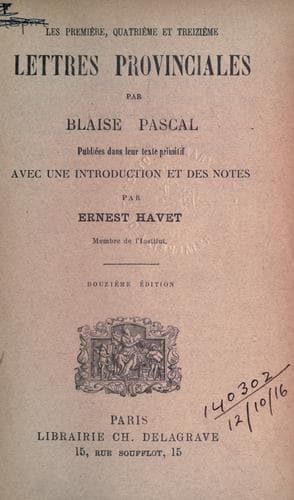
Lettres provinciales
الرسائل الإقليمية
Editorial summary
Blaise Pascal's Lettres provinciales represents a masterful intervention in seventeenth-century theological controversy that illuminates fundamental questions about divine grace, human agency, and moral theology. Written between 1656 and 1657 under the pseudonym Louis de Montalte, these eighteen letters ostensibly address a provincial friend while mounting a sophisticated defense of Jansenist theology against Jesuit casuistry. The work emerges from Pascal's association with Port-Royal and the condemnation of Antoine Arnauld, whose theological positions on grace Pascal champions through satirical yet philosophically rigorous argumentation.
The letters systematically examine the relationship between divine sovereignty and human moral responsibility, a central concern in debates about God's nature and interaction with creation. Pascal critiques what he presents as Jesuit laxism in moral theology, particularly their doctrine of probabilism, which permits following any probable opinion supported by recognized theologians. Through detailed analysis of casuistical manuals, Pascal argues that such approaches evacuate genuine moral obligation and distort the demanding nature of Christian ethics. His critique extends beyond ecclesiastical politics to fundamental questions about how divine law relates to human conscience and action.
Methodologically, Pascal combines rhetorical brilliance with theological precision, employing irony and logical analysis to expose what he considers dangerous compromises in Jesuit moral teaching. The work demonstrates how competing conceptions of God generate divergent ethical systems. Pascal's Jansenist sympathies lead him to emphasize divine grace's necessity and human corruption's depth, presenting a God whose holiness demands authentic conversion rather than minimal compliance. The Jesuits, in Pascal's portrayal, reduce divine requirements to accommodate human weakness, thereby misrepresenting both God's character and humanity's calling.
The Lettres provinciales significantly influenced subsequent discussions about religious authority, moral reasoning, and the nature of divine-human relations. Pascal's critique of casuistry raises enduring questions about whether systematic moral theology can adequately capture divine will or whether it inevitably reduces transcendent demands to manageable human categories. The work's literary power and philosophical acuity established it as a classic of French prose while contributing to broader Enlightenment debates about reason, revelation, and religious authority. Its treatment of grace, freedom, and moral obligation continues to inform discussions about divine action and human responsibility in theological ethics.
Argument formulations engaged
Related works
Pascal, Blaise (1657). Lettres provinciales. Good Press.
@book{lettres-provinciales-1657,
  author    = {Pascal, Blaise},
  title     = {Lettres provinciales},
  year      = {1657},
  publisher = {Good Press},
  url       = {https://god-database.com/en/works/lettres-provinciales-1657}
}