
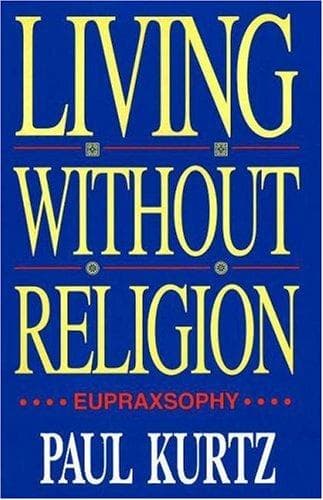
Living Without Religion: Eupraxophy
العيش بلا دين: الفعل الحسن
Vivre sans religion : eupraxophie
Editorial summary
This monograph presents Paul Kurtz's systematic articulation of eupraxophy, a comprehensive philosophical framework for ethical living without religious foundations. Kurtz constructs this neologism from Greek roots meaning "good practice" and "wisdom," positioning it as a naturalistic alternative to traditional religious worldviews. The work develops a secular philosophy that encompasses metaphysical naturalism, scientific methodology, and humanistic ethics while explicitly rejecting supernatural claims and religious authority.
Kurtz structures his argument around three interconnected components. First, he advances philosophical naturalism as the metaphysical foundation, arguing that the universe operates according to natural laws without supernatural intervention. Second, he champions scientific inquiry as the primary method for understanding reality and solving human problems. Third, he develops a humanistic ethics based on reason, empathy, and shared human values rather than divine commands or religious tradition. This tripartite framework directly challenges religious epistemology and moral authority.
The work engages critically with both traditional religious worldviews and what Kurtz perceives as insufficient secular alternatives. He argues that mere atheism or agnosticism fails to provide the comprehensive life stance that religions offer their adherents. Eupraxophy emerges as his solution: a complete philosophical system that addresses existential questions, moral guidance, and community belonging without recourse to transcendent beliefs. Kurtz particularly targets religious fundamentalism and New Age spirituality as incompatible with scientific rationality and human progress.
Methodologically, Kurtz employs philosophical argumentation supplemented by appeals to scientific evidence and humanistic values. He draws from the tradition of American pragmatism, particularly John Dewey's naturalistic philosophy, while incorporating insights from contemporary secular humanism. The work reflects Kurtz's broader intellectual project of establishing secular humanism as a viable alternative to religious worldviews in late twentieth-century America.
The monograph's significance lies in its ambitious attempt to construct a comprehensive secular philosophy that matches religion's scope while maintaining naturalistic commitments. Rather than simply critiquing religious belief, Kurtz offers a constructive alternative that addresses the human needs traditionally met by religion. This positions eupraxophy within broader debates about secularization, the relationship between science and values, and the possibility of meaning without transcendence. The work represents a notable contribution to secular philosophy, providing both theoretical foundations and practical guidance for those seeking to live meaningful lives without religious belief.
Argument formulations engaged
Kurtz, Paul (1994). Living Without Religion: Eupraxophy. Prometheus Books.
@book{living-without-religion-eupraxophy-1994,
  author    = {Kurtz, Paul},
  title     = {Living Without Religion: Eupraxophy},
  year      = {1994},
  publisher = {Prometheus Books},
  url       = {https://god-database.com/en/works/living-without-religion-eupraxophy-1994}
}