
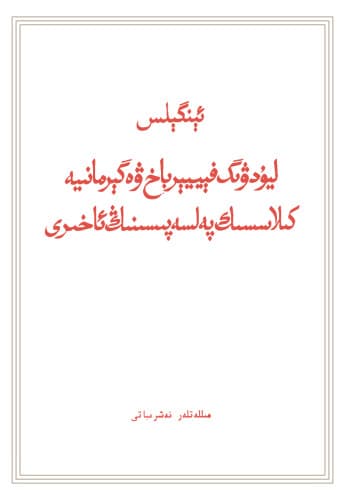
Ludwig Feuerbach and the End of Classical German Philosophy
لودفيغ فويرباخ ونهاية الفلسفة الألمانية الكلاسيكية
Ludwig Feuerbach et la fin de la philosophie allemande classique
Editorial summary
This monograph represents Engels' systematic exposition of historical materialism through a critical engagement with Ludwig Feuerbach's philosophy of religion. Writing four decades after he and Marx first formulated their materialist conception of history, Engels uses this retrospective analysis to clarify the relationship between German idealism, Feuerbach's anthropological critique of religion, and Marxist materialism. The work serves simultaneously as intellectual history and philosophical polemic, demonstrating how the critique of religion necessarily evolves into the critique of social conditions.
Engels presents Feuerbach's achievement as the decisive break with Hegelian idealism through the recognition that religion constitutes humanity's self-alienation. According to Engels' reading, Feuerbach correctly identified God as a projection of human essence, whereby human beings attribute their own highest qualities to an imaginary divine being. This anthropological reduction of theology marks a crucial advance beyond Hegel's speculative reconciliation of religion and philosophy. However, Engels argues that Feuerbach's analysis remains incomplete because it fails to explain why humans create such projections and under what conditions they might cease doing so.
The text develops a materialist explanation for religious consciousness that locates its origins in specific historical and social conditions rather than in abstract human nature. Engels contends that religious ideas reflect and mystify real social relations, particularly those of class society. Where Feuerbach saw religion as an eternal feature of human psychology, Engels insists it emerges from determinate material circumstances: social powerlessness, economic exploitation, and the inability to control natural and social forces. This analysis transforms atheism from a merely intellectual position into a practical project requiring social transformation.
Engels' contribution to debates about God lies in his methodological innovation. Rather than engaging in metaphysical arguments about divine existence or psychological analyses of religious need, he proposes a historical science of religion that examines its social functions and material preconditions. The work suggests that neither philosophical criticism nor scientific enlightenment alone can eliminate religious consciousness; only the practical transformation of the social conditions that generate religion can achieve this end. This position establishes a distinctly Marxist approach to the question of God that remains influential in sociology of religion and critical theory, one that treats atheism not as a philosophical conclusion but as a historical possibility dependent on human emancipation.
Argument formulations engaged
Related works
Engels, Friedrich (1886). Ludwig Feuerbach and the End of Classical German Philosophy.
@book{ludwig-feuerbach-and-the-end-of-classica,
  author    = {Engels, Friedrich},
  title     = {Ludwig Feuerbach and the End of Classical German Philosophy},
  year      = {1886},
  url       = {https://god-database.com/en/works/ludwig-feuerbach-and-the-end-of-classical-german-philosophy-1886}
}