
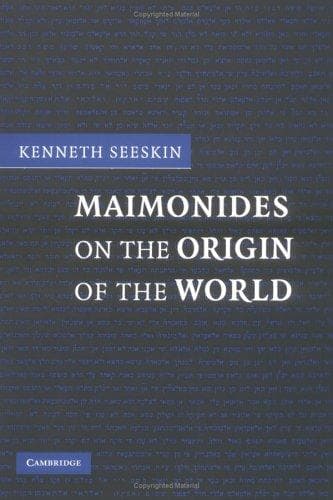
Maimonides on the Origin of the World
ميمونيدس حول أصل العالم
Maïmonide sur l'origine du monde
Editorial summary
This monograph examines Maimonides's complex position on the origin of the world, one of the most contested issues in medieval philosophy. Seeskin analyzes how Maimonides navigates between the Aristotelian doctrine of eternal existence and the biblical account of creation ex nihilo, ultimately defending a nuanced form of creationism that resists simple categorization. The study explores Maimonides's treatment of this question primarily in the Guide of the Perplexed, while drawing on his legal and philosophical corpus to illuminate his broader theological commitments.
Seeskin demonstrates that Maimonides rejects both the Aristotelian proof for eternity and the Kalam arguments for creation, finding neither philosophically demonstrative. Instead, Maimonides argues that reason alone cannot settle the question definitively. This epistemological modesty leads him to accept creation on the basis of prophecy and tradition, though not without philosophical justification. Seeskin shows how Maimonides develops a sophisticated critique of Aristotelian eternalism, arguing that it cannot adequately account for the possibility of divine will and providence. The eternal universe of Aristotle operates by necessity, leaving no room for a God who chooses and acts freely in history.
The work situates Maimonides's position within the broader medieval debate, showing how he differs from both Islamic philosophers like al-Ghazali and Averroes, and from Jewish predecessors like Saadia Gaon. Seeskin emphasizes that Maimonides's defense of creation serves his larger theological project: preserving the possibility of miracles, providence, and revelation while maintaining philosophical rigor. The analysis reveals how Maimonides employs negative theology and the doctrine of divine attributes to argue that God's creative act transcends human categories of understanding.
Seeskin's contribution lies in demonstrating that Maimonides's position represents neither a simple harmonization of faith and reason nor a covert philosophical naturalism, but rather a subtle dialectic that preserves both philosophical inquiry and religious commitment. The study shows how Maimonides uses the limits of demonstrative knowledge to create space for revelation without abandoning rational investigation. This approach offers a model for how classical theism can engage philosophical challenges while maintaining core theological commitments about divine freedom and transcendence.
Argument formulations engaged
Related works
Seeskin, Kenneth (2005). Maimonides on the Origin of the World. Cambridge University Press.
@book{maimonides-on-the-origin-of-the-world-20,
  author    = {Seeskin, Kenneth},
  title     = {Maimonides on the Origin of the World},
  year      = {2005},
  publisher = {Cambridge University Press},
  url       = {https://god-database.com/en/works/maimonides-on-the-origin-of-the-world-2005}
}