
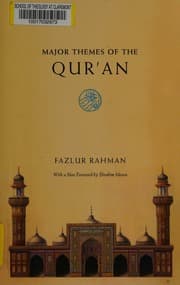
Major Themes of the Qur'an
المواضيع الرئيسية في القرآن
Thèmes majeurs du Coran
Editorial summary
This seminal work presents a comprehensive analysis of the Qur'an's theological worldview through systematic examination of its central themes rather than chronological or atomistic approaches. Rahman argues that the Qur'an possesses an organic unity centered on the concept of taqwa (God-consciousness) and demonstrates how all major themes interconnect to form a coherent religious vision. The work directly challenges both traditional Muslim exegesis, which often fragments the text into discrete legal rulings, and Orientalist scholarship that emphasizes historical discontinuities.
Rahman's methodology involves identifying recurring motifs across the Qur'anic text and synthesizing them into major thematic complexes. He examines eight primary themes: God, humanity and society, nature, prophethood, eschatology, evil and Satan, revelation, and the emergence of the Muslim community. Throughout, he emphasizes the Qur'an's fundamental theocentric orientation, arguing that every theme ultimately relates back to divine unity (tawhid) and human moral responsibility before God.
The work makes several significant contributions to understanding Islamic conceptions of divinity. Rahman demonstrates how the Qur'an presents God as simultaneously transcendent and immanent, merciful and just, while rejecting both anthropomorphic literalism and abstract philosophical deity. He shows how Qur'anic monotheism differs from biblical traditions through its emphasis on divine unity without trinity or incarnation, and its integration of natural theology with revealed guidance. Particularly notable is his analysis of how the Qur'an's God-concept shapes its ethics, law, and social vision.
Rahman's intellectual context straddles traditional Islamic scholarship and modern critical methods. Writing as a Muslim modernist, he seeks to recover what he considers the Qur'an's original message while engaging seriously with contemporary philosophical and historical criticism. His work implicitly critiques both secular reductionism that treats religious texts as merely human productions and fundamentalist readings that ignore historical context and thematic coherence.
This monograph remains influential for several reasons. It provides a sophisticated insider account of Islamic theology accessible to non-Muslim readers while maintaining scholarly rigor. It demonstrates how scripture can be read as presenting coherent theological arguments rather than mere assertions. Most importantly, it shows how the Qur'anic conception of God generates a comprehensive worldview encompassing individual spirituality, social ethics, and cosmic purpose. For scholars of comparative theology and philosophy of religion, Rahman offers crucial insights into how Islamic monotheism constructs its distinctive understanding of divine-human relations.
Argument formulations engaged
Related works
Rahman, F. (1980). Major Themes of the Qur'an. Bibliotheca Islamica.
@book{major-themes-of-the-quran-1980,
  author    = {Rahman, F.},
  title     = {Major Themes of the Qur'an},
  year      = {1980},
  publisher = {Bibliotheca Islamica},
  url       = {https://god-database.com/en/works/major-themes-of-the-quran-1980}
}