
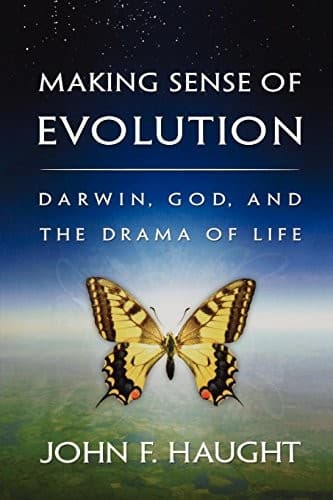
Making Sense of Evolution: Darwin, God, and the Drama of Life
فهم التطور: داروين والله ودراما الحياة
Donner un sens à l'évolution : Darwin, Dieu et le drame de la vie
Editorial summary
John F. Haught's Making Sense of Evolution: Darwin, God, and the Drama of Life presents a theological framework that embraces evolutionary theory while maintaining that evolution itself points toward divine purpose. Writing as a Roman Catholic theologian, Haught argues that properly understood, Darwinian evolution enriches rather than diminishes theological reflection about God's relationship to creation.
The work directly challenges both scientific materialists who claim evolution eliminates the need for God and religious fundamentalists who reject evolutionary science to preserve biblical literalism. Haught contends that both positions rest on the same flawed assumption: that divine action and natural processes constitute mutually exclusive explanatory categories. Against this dichotomy, he develops what he terms a "theology of evolution" that locates God's creative activity precisely within the unpredictable, open-ended process of cosmic and biological development.
Central to Haught's argument is his appropriation of process theology and the concept of divine kenosis (self-emptying). He proposes that God creates by withdrawing to allow genuine novelty and freedom within creation, making room for the world to become itself through evolutionary processes. This theological move enables him to interpret the apparent randomness and suffering inherent in evolution not as evidence against divine goodness but as necessary features of a universe granted authentic autonomy by a self-limiting God.
The author draws extensively on Pierre Teilhard de Chardin's vision of cosmic evolution moving toward greater complexity and consciousness, ultimately oriented toward what Teilhard called the Omega Point. Haught updates this framework by engaging contemporary evolutionary biology and cosmology, arguing that the universe displays a fundamental tendency toward increasing beauty, complexity, and intensity of experience that suggests divine allurement rather than mere chance.
Methodologically, Haught employs a synthetic approach that weaves together biblical theology, philosophical reflection, and engagement with scientific literature. He explicitly positions his work within the broader science and religion dialogue, particularly responding to the New Atheist movement's use of evolution as an argument against theism. His theological interpretation of evolution serves both as constructive theology and as apologetics, demonstrating how Christian faith can fully embrace scientific discoveries while maintaining its distinctive claims about ultimate reality. The work represents a significant contribution to contemporary natural theology by showing how evolution, rather than displacing God, reveals new dimensions of divine creativity and presence.
Argument formulations engaged
Related works
Haught, John F. (2010). Making Sense of Evolution: Darwin, God, and the Drama of Life. Westminster John Knox Press.
@book{making-sense-of-evolution-darwin-god-and,
  author    = {Haught, John F.},
  title     = {Making Sense of Evolution: Darwin, God, and the Drama of Life},
  year      = {2010},
  publisher = {Westminster John Knox Press},
  url       = {https://god-database.com/en/works/making-sense-of-evolution-darwin-god-and-the-drama-of-life-2010}
}