
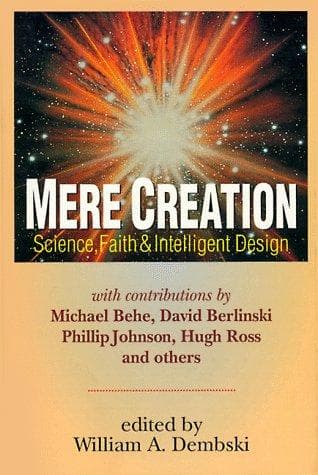
Mere Creation: Science, Faith and Intelligent Design
خلق بسيط: العلم والإيمان والتصميم الذكي
Simple Création : Science, Foi et Dessein Intelligent
Editorial summary
This edited volume emerges from the 1996 Mere Creation conference, representing a foundational moment in the intelligent design movement's attempt to establish scientific credibility. Dembski assembles contributions from mathematicians, philosophers, biologists, and theologians who collectively argue that certain features of the natural world exhibit complexity patterns inexplicable through undirected natural processes alone. The work positions intelligent design as a scientific research program distinct from traditional creationism, though critics note the movement's theological motivations.
The volume's central thesis contends that specified complexity and irreducible complexity in biological systems point toward intelligent causation. Contributors develop this argument across multiple disciplines. Behe elaborates his concept of irreducible complexity through molecular machines like bacterial flagella. Meyer examines information theory and the origin of biological information. Nelson and Wells critique methodological naturalism's limitations in biology. Dembski himself presents his explanatory filter for detecting design, arguing that when natural law and chance prove insufficient, design inference becomes scientifically legitimate.
The work explicitly challenges neo-Darwinian evolution's adequacy as a comprehensive explanation for biological diversity and complexity. Contributors argue that naturalistic evolution fails to account for the origin of biological information, the Cambrian explosion's sudden appearance of complex body plans, and the fine-tuning of cosmological constants. However, the volume strategically avoids identifying the designer, maintaining focus on design detection rather than designer identity to preserve claimed scientific neutrality.
Methodologically, the collection employs probability theory, information science, and philosophy of science to construct its case. Contributors draw parallels between human design detection in archaeology or forensics and proposed design detection in nature. This approach attempts to establish intelligent design within accepted scientific practice rather than as external religious critique.
The volume's significance lies in crystallizing intelligent design's intellectual framework and aspirations. It articulates core concepts that would dominate subsequent debate: specified complexity, irreducible complexity, and the explanatory filter. While mainstream science rejected these arguments as repackaged creationism, the work succeeded in generating extensive academic discussion about naturalism's scope, design inference, and science's methodological boundaries. The collection thus represents intelligent design's most sophisticated attempt to present itself as a scientific alternative to naturalistic evolution, regardless of its ultimate reception within professional scientific communities.
Argument formulations engaged
Dembski, William (1998). Mere Creation: Science, Faith and Intelligent Design. InterVarsity Press.
@book{mere-creation-science-faith-and-intellig,
  author    = {Dembski, William},
  title     = {Mere Creation: Science, Faith and Intelligent Design},
  year      = {1998},
  publisher = {InterVarsity Press},
  url       = {https://god-database.com/en/works/mere-creation-science-faith-and-intelligent-design-1998}
}