
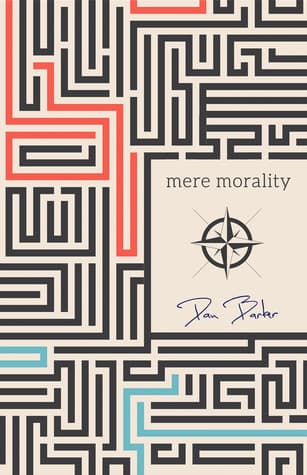
Mere Morality
أخلاق بسيطة
Simple Moralité
Editorial summary
Dan Barker's "Mere Morality" presents a systematic argument for secular ethics while challenging the claim that morality requires religious grounding. As a former evangelical preacher turned atheist activist, Barker brings unique perspective to this philosophical debate, combining formal argumentation with personal insight into religious moral reasoning.
The work directly confronts C.S. Lewis's influential "Mere Christianity," which argues that universal moral intuitions point toward divine origin. Barker inverts this logic, contending that morality emerges naturally from human experience and evolutionary development rather than supernatural decree. His central thesis maintains that secular ethics provides a more coherent and practical foundation for moral behavior than religious systems.
Barker develops his argument through several interconnected claims. First, he demonstrates that moral intuitions predate and transcend religious traditions, appearing across cultures regardless of theological beliefs. Second, he argues that religious morality often contradicts basic ethical principles, citing scriptural endorsements of slavery, genocide, and gender inequality. Third, he proposes that evolutionary biology and social psychology adequately explain moral development without invoking supernatural causes.
The author employs a methodological approach combining philosophical analysis with empirical evidence from anthropology, neuroscience, and comparative religion. He examines specific moral dilemmas to illustrate how secular reasoning produces more consistent and humane outcomes than divine command theory. Particularly significant is his treatment of the Euthyphro dilemma, arguing that if morality depends on God's commands, it becomes arbitrary, while if God commands what is independently good, then morality exists apart from deity.
Barker's contribution to contemporary debates extends beyond academic philosophy to public discourse about religion's role in society. His work engages with contemporary defenders of religious ethics, including William Lane Craig and Alvin Plantinga, while drawing on secular moral philosophers like Peter Singer and Sam Harris. The book addresses practical implications for law, education, and public policy, arguing that secular societies demonstrate superior moral outcomes in measurable areas like crime rates, social welfare, and human rights.
"Mere Morality" stands as a comprehensive challenge to religious claims of moral authority, offering instead a naturalistic account of ethics grounded in human wellbeing and rational reflection. Its significance lies not merely in refuting religious arguments but in constructing a positive vision for secular moral philosophy accessible to general audiences while maintaining philosophical rigor.
Argument formulations engaged
Related works
Barker, Dan (2018). Mere Morality. Freedom From Religion Foundation.
@book{mere-morality-2018,
  author    = {Barker, Dan},
  title     = {Mere Morality},
  year      = {2018},
  publisher = {Freedom From Religion Foundation},
  url       = {https://god-database.com/en/works/mere-morality-2018}
}