
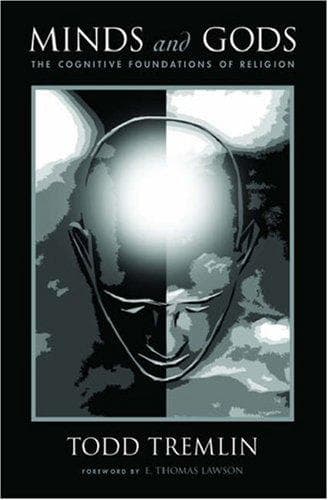
Minds and Gods.. The Cognitive Foundations of Religion
العقول والآلهة.. الأسس المعرفية للدين
Esprits et dieux.. Les fondements cognitifs de la religion
Religious belief in gods is not a cultural accident but a predictable output of universal cognitive mechanisms — particularly agency detection and intuitive reasoning — that make minds naturally disposed toward theistic concepts.
Editorial summary
Todd Tremlin's "Minds and Gods: The Cognitive Foundations of Religion" offers a comprehensive examination of religious belief through the lens of cognitive science, exploring how evolved mental mechanisms naturally generate and sustain religious concepts across human cultures. Drawing on research from evolutionary psychology, anthropology, and neuroscience, Tremlin argues that religious thinking emerges from ordinary cognitive processes rather than from special revelation or cultural indoctrination alone.
The work engages primarily with naturalistic explanations of religion, building upon the pioneering research of scholars like Pascal Boyer, Scott Atran, and Justin Barrett. Tremlin synthesizes their findings to present a unified cognitive theory of religion that explains why certain religious concepts prove more memorable and transmissible than others. Central to his argument is the claim that human minds possess evolved cognitive systems—including agency detection, theory of mind, and intuitive ontologies—that make supernatural agent concepts both easy to generate and compelling to believe.
Tremlin's method involves careful analysis of experimental data from cognitive psychology and cross-cultural studies, demonstrating how universal cognitive constraints shape religious diversity. He shows how minimally counterintuitive concepts—those that violate one or two intuitive expectations while preserving others—achieve optimal memorability and cultural success. Gods, as agents with counterintuitive properties like omniscience or invisibility, exemplify such concepts perfectly.
The monograph's significance lies in its systematic application of cognitive science to religious phenomena without reducing religion to mere error or pathology. While Tremlin explains religious belief naturalistically, he maintains a descriptive stance that neither endorses nor dismisses the truth claims of religious traditions. His work challenges both theological accounts that ignore cognitive constraints and skeptical approaches that fail to explain religion's persistence and power.
By grounding religious cognition in evolved mental architecture, Tremlin provides tools for understanding why humans across cultures spontaneously generate god concepts, why certain theological ideas spread more successfully than others, and why religious belief remains resilient in modern societies. His contribution advances the cognitive science of religion as a rigorous research program, offering testable hypotheses about the relationship between mental processes and religious phenomena while remaining neutral on metaphysical questions about divine existence.
Structured analysis
Structure of the work
Argument formulations engaged
Related works
Tremlin, Todd (2006). Minds and Gods.. The Cognitive Foundations of Religion. Oxford University Press.
@book{minds-and-gods-the-cognitive-foundations,
  author    = {Tremlin, Todd},
  title     = {Minds and Gods.. The Cognitive Foundations of Religion},
  year      = {2006},
  publisher = {Oxford University Press},
  url       = {https://god-database.com/en/works/minds-and-gods-the-cognitive-foundations-of-religion}
}