
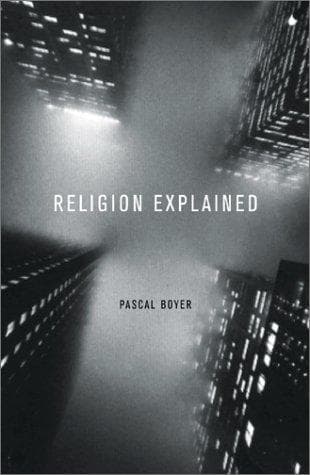
Religion Explained
تفسير الدين
La religion expliquée
Editorial summary
Pascal Boyer's Religion Explained presents a comprehensive cognitive and evolutionary account of religious phenomena, arguing that religious beliefs emerge naturally from ordinary human mental processes rather than from any divine source or special religious faculty. Boyer, an anthropologist and cognitive scientist, synthesizes research from cognitive psychology, evolutionary biology, and cross-cultural anthropology to demonstrate that religious concepts systematically exploit universal features of human cognition that evolved for other purposes.
The work directly challenges both theological explanations of religion as divinely inspired and earlier anthropological theories that treated religion as addressing existential anxieties or promoting social cohesion. Boyer argues instead that religious representations persist because they achieve an optimal balance between counterintuitiveness and memorability. Religious concepts typically violate one or two basic ontological categories while preserving most intuitive expectations—a statue that hears prayers, for instance, violates physics but maintains psychological properties. This "minimally counterintuitive" structure makes religious ideas attention-grabbing yet cognitively manageable.
Boyer identifies several cognitive systems particularly relevant to religious thinking: agency detection mechanisms that make humans prone to seeing intention in natural events; social cognition modules that enable representation of unseen agents; moral intuitions that connect to notions of supernatural punishment; and coalition psychology that underlies religious group dynamics. These systems, Boyer contends, evolved to handle practical problems of survival and cooperation but incidentally generate religious byproducts when operating in concert.
The book's naturalistic approach effectively dismantles any notion that religious belief requires special explanation or indicates divine reality. Boyer demonstrates that the universality of religion reflects common cognitive architecture rather than universal truth. His account explains not only why humans believe in gods but why these beliefs take the specific forms they do across cultures—why gods are typically portrayed as interested in moral behavior, why rituals follow particular patterns, and why certain religious concepts spread while others fail.
Religion Explained significantly advances the scientific study of religion by providing a unified theoretical framework grounded in empirical research. Boyer's cognitive approach offers more precise, testable hypotheses than previous functionalist or phenomenological theories. For the God debate, the work powerfully supports naturalistic explanations of religious belief, suggesting that the human tendency toward theism reveals more about evolved psychology than metaphysical reality. The book establishes that one can fully explain religion's origin, persistence, and structure without reference to any supernatural realm.
Argument formulations engaged
Related works
Boyer, Pascal (2001). Religion Explained.
@book{religion-explained-2001,
  author    = {Boyer, Pascal},
  title     = {Religion Explained},
  year      = {2001},
  url       = {https://god-database.com/en/works/religion-explained-2001}
}