
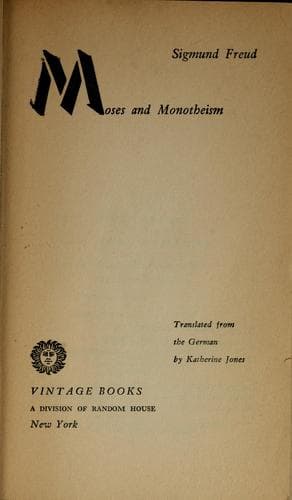
Moses and Monotheism
موسى والتوحيد
Moïse et le monothéisme
Freud argues that Moses was an Egyptian follower of Akhenaten's monotheism who imposed this religion on the Hebrews, was subsequently murdered by them, and that the resulting collective guilt became the psychological foundation of Jewish — and ultimately Christian — monotheism.
Editorial summary
This provocative work applies psychoanalytic theory to the origins of Jewish monotheism, proposing that Moses was an Egyptian nobleman who transmitted the monotheistic cult of Aten to the Hebrew people following Akhenaten's failed religious revolution. Freud argues that the Israelites subsequently murdered this Egyptian Moses in the wilderness, repressing the traumatic memory through the creation of a second, Midianite Moses figure. This primal patricide, he contends, established the psychological foundation for Judaism's distinctive religious consciousness and its later evolution into Christianity.
The monograph extends Freud's earlier theories from Totem and Taboo to explain monotheism as a neurotic symptom arising from collective guilt. The repressed memory of Moses's murder returns in distorted form through prophetic Judaism, while Christianity represents a more complete return of the repressed, acknowledging the son's guilt through the doctrine of original sin and achieving cathartic redemption through Christ's sacrificial death. Freud interprets religious rituals, prohibitions, and theological concepts as manifestations of unconscious processes rather than responses to divine revelation.
Methodologically, the work exemplifies psychoanalytic reductionism, treating religious phenomena as projections of psychological dynamics. Freud draws selectively on biblical scholarship, Egyptology, and anthropology to support his thesis, though his historical reconstructions remain highly speculative. His approach assumes that collective psychology operates analogously to individual neurosis, allowing him to diagnose entire religious traditions as exhibiting symptoms of repressed trauma.
The text contributes to naturalistic explanations of religion by offering a genetic account of monotheism's emergence without reference to supernatural causation. It challenges both traditional religious self-understanding and contemporary theological claims by reducing spiritual experiences to psychological mechanisms. While Freud acknowledges monotheism's cultural achievements, he ultimately pathologizes religious belief as an illusion serving defensive functions.
This work's significance lies less in its historical accuracy than in its influential model for understanding religion through depth psychology. It exemplifies the modern tendency to explain religious phenomena through secular frameworks, treating theological concepts as requiring demystification rather than engagement on their own terms. The monograph thus represents a thoroughgoing naturalistic challenge to theistic worldviews, proposing that psychoanalysis can decode religion's true meaning by uncovering its unconscious origins in trauma and guilt.
Structured analysis
Argument formulations engaged
Related works
Freud, Sigmund Moses and Monotheism.
@book{moses-and-monotheism,
  author    = {Freud, Sigmund},
  title     = {Moses and Monotheism},
  year      = {n.d.},
  url       = {https://god-database.com/en/works/moses-and-monotheism}
}