
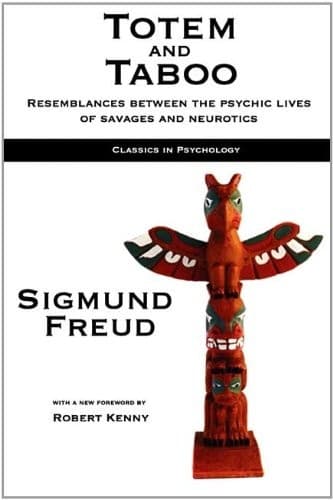
Totem and Taboo
الطوطم والتابو
Totem et Tabou
Editorial summary
This monograph presents Freud's psychoanalytic theory of religion's origins through an examination of primitive societies and their psychological parallels with neurotic behavior. Drawing on anthropological studies of Australian Aboriginal peoples and other tribal societies, Freud argues that religious belief emerges from fundamental psychological mechanisms rooted in guilt, fear, and the repression of primal desires.
At the work's center lies Freud's reconstruction of the "primal horde" scenario, where prehistoric humans allegedly lived in small groups dominated by a powerful father figure who monopolized sexual access to females. According to Freud's speculative narrative, the sons eventually banded together to kill and devour this primal father, an act that generated overwhelming guilt and remorse. This collective trauma, Freud contends, became the psychological template for all subsequent religious experience, with God functioning as a projected father-substitute who both prohibits and forgives.
The text systematically parallels religious practices with obsessional neurosis, suggesting that rituals, taboos, and sacred observances represent collective defensive mechanisms against repressed wishes. Freud interprets totemism—the worship of animal or plant symbols by tribal groups—as a displacement of ambivalent feelings toward the murdered father onto a substitute object. Similarly, he reads the incest taboo and exogamous marriage rules as cultural elaborations of the original patricidal guilt.
Methodologically, Freud synthesizes contemporary anthropological data with psychoanalytic interpretation, applying individual psychology to collective phenomena. He draws heavily on James Frazer's work on totemism and William Robertson Smith's theories of sacrificial ritual, while reinterpreting their findings through his distinctive psychological lens. This approach allows him to present religion not as divine revelation or even social construction, but as a universal neurosis of humanity arising from repressed historical trauma.
The work's significance for the God debate lies in its radical naturalization of religious phenomena. By locating religion's origins in psychological processes rather than metaphysical realities, Freud provides a comprehensive atheistic account that explains not only why humans believe in God, but why such belief persists despite its illusory character. This psychological reduction of religion would profoundly influence twentieth-century discussions of religious belief, forcing theologians and philosophers to grapple with the possibility that the sense of the sacred might be nothing more than sublimated guilt and projected paternal authority.
Argument formulations engaged
Related works
Freud, Sigmund (1913). Totem and Taboo. Hugo Heller.
@book{totem-and-taboo-1913,
  author    = {Freud, Sigmund},
  title     = {Totem and Taboo},
  year      = {1913},
  publisher = {Hugo Heller},
  url       = {https://god-database.com/en/works/totem-and-taboo-1913}
}