
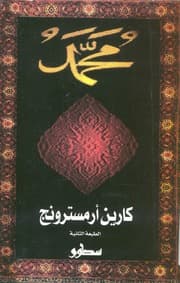
Muhammad: A Biography of the Prophet
محمد: سيرة النبي
Muhammad : Une Biographie du Prophète
Editorial summary
This biographical study of Muhammad examines the Prophet's life and teachings within their 7th-century Arabian context while addressing contemporary Western misconceptions about Islam. Armstrong approaches her subject through historical-critical methodology, drawing on early Islamic sources including Ibn Ishaq's biography, hadith collections, and the Quran itself, while situating Muhammad's career against the social, economic, and religious landscape of pre-Islamic Arabia.
The work traces Muhammad's evolution from merchant to prophet, analyzing how his monotheistic message emerged within a polytheistic tribal society experiencing rapid social change. Armstrong argues that Muhammad's revelation addressed specific crises in Meccan society, including economic inequality, tribal warfare, and the breakdown of traditional kinship bonds. She interprets Islamic monotheism not as an abstract theological proposition but as a practical response to social fragmentation, presenting Allah as the single divine authority capable of uniting disparate tribes under universal ethical principles.
Armstrong challenges several Western stereotypes, particularly regarding jihad, women's status, and Muhammad's multiple marriages. She contextualizes these within 7th-century Arabian customs and the precarious position of early Muslims, arguing that Muhammad's reforms generally improved women's legal status relative to pre-Islamic norms. The biography emphasizes Islam's initial tolerance toward other monotheistic faiths, presenting Muhammad's conflicts with Jewish tribes as political rather than theological disputes.
The work's significance for discussions about God lies in its presentation of Islamic monotheism as both continuous with and distinct from Jewish and Christian traditions. Armstrong portrays Muhammad not as introducing a new deity but as reforming Arabian understanding of the God already known through previous revelations. She emphasizes the Quran's insistence on divine unity (tawhid) as a corrective to Christian trinitarianism and pagan polytheism alike.
While not engaging in philosophical arguments for God's existence, Armstrong's historical approach illuminates how Islamic monotheism functioned as a social and spiritual force. Her sympathetic yet scholarly treatment provides important context for understanding Islamic contributions to monotheistic thought. The biography serves dialogical purposes by promoting interfaith understanding, implicitly arguing that accurate historical knowledge can reduce religious conflict. By presenting Muhammad's prophetic career as a historically comprehensible phenomenon responding to specific social conditions, Armstrong offers a naturalistic account that neither affirms nor denies the supernatural claims of Islamic tradition.
Argument formulations engaged
Armstrong, Karen (1991). Muhammad: A Biography of the Prophet. HarperSanFrancisco.
@book{muhammad-a-biography-of-the-prophet-1991,
  author    = {Armstrong, Karen},
  title     = {Muhammad: A Biography of the Prophet},
  year      = {1991},
  publisher = {HarperSanFrancisco},
  url       = {https://god-database.com/en/works/muhammad-a-biography-of-the-prophet-1991}
}