
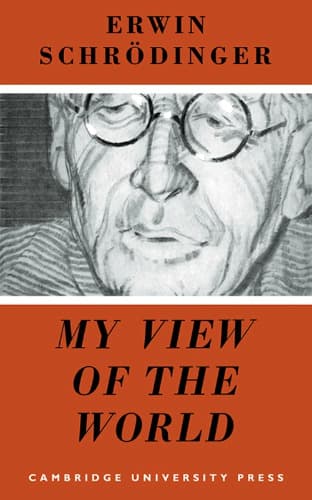
My View of the World
رؤيتي للعالم
Ma vision du monde
A scientist's personal worldview, shaped by quantum physics and Vedantic philosophy, holds that consciousness is singular and universal, dissolving the boundary between self and world in a way that has deep implications for any account of mind, nature, and the divine.
Editorial summary
Erwin Schrödinger's "My View of the World" represents a significant contribution from one of quantum mechanics' founding figures to philosophical questions about consciousness, reality, and ultimate meaning. Writing in 1951, Schrödinger ventures beyond physics to explore metaphysical territory, offering a unique perspective shaped by both his scientific work and his engagement with Eastern philosophy, particularly Vedantic thought.
The work centers on the relationship between consciousness and physical reality, a problem Schrödinger approaches through his distinctive interpretation of quantum mechanics and its implications for understanding mind and matter. He argues that the conventional scientific worldview, which treats consciousness as an epiphenomenon of material processes, faces insurmountable difficulties when confronted with the observer problem in quantum mechanics. Instead, Schrödinger proposes a form of metaphysical monism that bears striking resemblance to Advaita Vedanta, suggesting that individual consciousness participates in a singular, universal consciousness.
Schrödinger's methodology combines rigorous scientific reasoning with philosophical speculation, drawing on his authority as a physicist while acknowledging the limits of empirical science in addressing fundamental questions about existence. He explicitly engages with the mechanistic worldview that dominated early twentieth-century science, arguing that it cannot adequately account for the phenomenon of consciousness or the apparent unity of subjective experience. His critique extends to naive materialism and its failure to explain how subjective experience emerges from objective physical processes.
The monograph's significance lies in its challenge to the strict separation between scientific and religious or mystical discourse. Schrödinger demonstrates how quantum mechanics itself points toward questions traditionally reserved for theology or metaphysics. While he does not argue for a personal deity, his vision of universal consciousness and the interconnectedness of all existence resonates with certain mystical traditions, both Eastern and Western.
The work matters for the God debate because it exemplifies how modern physics can lead to worldviews that, while not traditionally theistic, nevertheless reject purely materialistic explanations of reality. Schrödinger's synthesis of scientific insight and philosophical reflection offers a model for dialogue between science and religion that avoids both dogmatic materialism and anti-scientific spiritualism. His influence extends across disciplines, inspiring both physicists interested in consciousness and philosophers seeking to integrate scientific discoveries into broader metaphysical frameworks.
Structured analysis
Argument formulations engaged
Schroedinger, Erwin (1951). My View of the World.
@book{my-view-of-the-world,
  author    = {Schroedinger, Erwin},
  title     = {My View of the World},
  year      = {1951},
  url       = {https://god-database.com/en/works/my-view-of-the-world}
}