
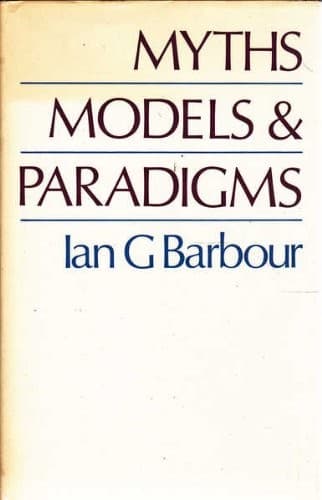
Myths, Models and Paradigms
الأساطير والنماذج والنماذج المعرفية
Mythes, Modèles et Paradigmes
Editorial summary
This influential monograph examines the role of conceptual frameworks in both religious and scientific thought, arguing that both domains employ models and paradigms that shape interpretation and understanding. Barbour challenges the rigid separation between scientific objectivity and religious subjectivity by demonstrating structural parallels in how both fields construct and employ theoretical frameworks.
The work develops a sophisticated analysis of religious language that moves beyond simplistic literal versus symbolic dichotomies. Barbour argues that religious models function analogously to scientific models - as interpretive schemes that organize experience while remaining open to revision. He contends that myths, properly understood, serve as comprehensive interpretive frameworks rather than primitive explanations, providing existential orientation and practical wisdom within communities of faith.
Central to Barbour's argument is his application of Thomas Kuhn's paradigm theory to religious thought. Just as scientific paradigms shape observation and interpretation in science, religious paradigms influence how believers perceive and respond to ultimate reality. This parallel suggests that neither science nor religion operates through pure empiricism or revelation, but rather through interpretive communities employing conceptual frameworks to make sense of experience.
The monograph directly challenges logical positivism's dismissal of religious language as meaningless. Against those who would restrict cognitive significance to empirically verifiable statements, Barbour demonstrates that both scientific and religious discourse rely on metaphorical models that extend beyond literal description. He argues that religious language possesses cognitive content while serving additional functions including personal transformation and communal identity formation.
Barbour's critical realism emerges as a mediating position between naive realism and instrumentalism. Religious models, like scientific ones, aim to represent reality while acknowledging their provisional and partial character. This approach preserves truth claims in religious discourse without demanding literal correspondence between models and divine reality.
The work's significance lies in establishing methodological bridges between science and religion without reducing either to the other. By showing how both employ models, metaphors, and paradigms, Barbour undermines warfare narratives of science-religion conflict while avoiding facile harmonization. His framework enables sophisticated analysis of how religious communities develop, test, and revise their understanding of ultimate reality through ongoing interaction between tradition and experience. This contribution remains foundational for contemporary science-religion dialogue, offering resources for those seeking intellectually responsible faith in a scientific age.
Argument formulations engaged
Barbour, Ian (1974). Myths, Models and Paradigms.
@book{myths-models-and-paradigms-1974,
  author    = {Barbour, Ian},
  title     = {Myths, Models and Paradigms},
  year      = {1974},
  url       = {https://god-database.com/en/works/myths-models-and-paradigms-1974}
}