
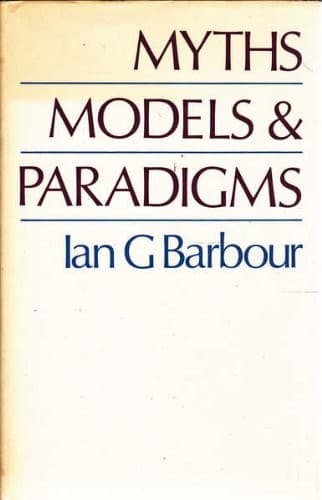
Myths, Models and Paradigms: A Comparative Study in Science and Religion
الأساطير والنماذج والنماذج المعرفية: دراسة مقارنة في العلم والدين
Mythes, Modèles et Paradigmes : Une Étude Comparative en Science et Religion
Editorial summary
Barbour's seminal work examines the structural similarities between scientific and religious thought through the lens of language, models, and paradigms. The monograph challenges the prevailing assumption that science and religion operate according to fundamentally different epistemological principles, arguing instead that both disciplines employ analogous cognitive frameworks in their attempts to understand reality.
Central to Barbour's analysis is the concept of models as imaginative constructs that mediate between abstract theories and concrete experience. He demonstrates that scientific models, like religious models, function metaphorically rather than literally, providing interpretive frameworks that shape observation and understanding. The wave-particle duality in quantum mechanics, for instance, parallels the personal-impersonal duality in theological descriptions of God. Neither scientific nor religious models should be understood as direct photographs of reality but rather as conceptual tools that highlight certain aspects while obscuring others.
Barbour extends Thomas Kuhn's notion of paradigms beyond science to encompass religious communities. He argues that religious traditions, like scientific communities, operate within overarching paradigms that determine which questions are meaningful, what counts as evidence, and how data should be interpreted. These paradigms are not simply theoretical constructs but embody entire worldviews sustained by particular communities of practice.
The work critiques both naive realism and instrumentalism in science and religion. Against logical positivists who dismiss religious language as meaningless, Barbour shows that scientific language itself relies on metaphorical and model-based thinking. Conversely, against religious fundamentalists who treat doctrinal statements as literal descriptions, he emphasizes the symbolic and interpretive nature of theological claims.
Barbour's contribution to the God debate lies not in defending or attacking theistic belief but in reframing the entire discussion. By demonstrating the epistemological parallels between scientific and religious inquiry, he undermines simplistic narratives about the conflict between faith and reason. His work suggests that the question of God cannot be resolved through appeals to scientific methodology alone, since science itself depends on imaginative models and paradigm-dependent interpretation.
The monograph's lasting influence stems from its sophisticated treatment of how human beings construct knowledge in both scientific and religious domains. Barbour's analysis opens space for dialogue between science and religion by showing that both enterprises share fundamental cognitive strategies, even as they differ in their specific methods and criteria for evaluation.
Argument formulations engaged
Related works
Barbour, Ian G. (1974). Myths, Models and Paradigms: A Comparative Study in Science and Religion.
@book{myths-models-and-paradigms-a-comparative,
  author    = {Barbour, Ian G.},
  title     = {Myths, Models and Paradigms: A Comparative Study in Science and Religion},
  year      = {1974},
  url       = {https://god-database.com/en/works/myths-models-and-paradigms-a-comparative-study-in-science-and-religion-1974}
}