
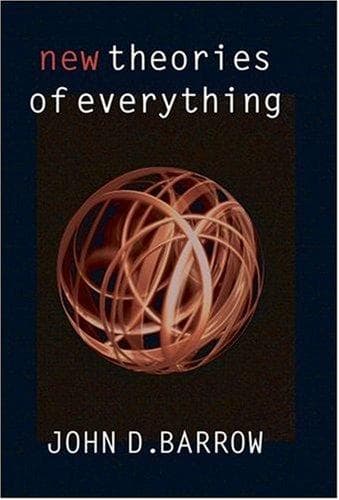
New Theories of Everything
نظريات جديدة لكل شيء
Nouvelles théories du tout
No single 'theory of everything' can fully account for the existence, laws, and fine-tuned structure of the universe, leaving fundamental questions about ultimate explanation permanently open.
Editorial summary
In New Theories of Everything, John D. Barrow examines the philosophical and scientific quest for unified explanations of reality, exploring how contemporary physics intersects with perennial questions about ultimate reality and divine design. The work analyzes the conceptual evolution from classical deterministic frameworks to modern theories that grapple with fundamental limits of knowledge, contingency, and the apparent fine-tuning of physical constants.
Barrow traces how successive "theories of everything" from Newton through Einstein to contemporary string theory have progressively revealed deeper layers of complexity rather than simple unification. He demonstrates that each attempt to achieve complete explanation encounters new mysteries: quantum indeterminacy, cosmological horizons, and the peculiar life-permitting values of fundamental constants. This progression frames his central thesis that scientific totalization inevitably confronts metaphysical questions traditionally associated with theological discourse.
The work engages substantively with both cosmological and fine-tuning arguments, though from a descriptive rather than advocative stance. Barrow analyzes how modern cosmology's discovery of cosmic beginning conditions and expansion parameters revives classical questions about first causes, while the anthropic coincidences in physical constants suggest design-like features requiring explanation. He examines various responses including multiverse theories, selection effects, and necessity arguments, showing how each proposed solution generates new philosophical puzzles.
Methodologically, Barrow employs philosophy of science to illuminate the conceptual architecture underlying physical theories. He demonstrates how mathematical frameworks encode metaphysical assumptions about causation, necessity, and contingency that bear directly on theological questions. His analysis reveals that theories of everything necessarily invoke philosophical choices about the nature of explanation itself—whether terminating in brute facts, necessary beings, or infinite regresses.
The work's significance lies in its sophisticated mapping of the contemporary science-theology interface. Barrow shows how cutting-edge physics unavoidably encounters limit questions traditionally addressed by natural theology, while resisting both naive concordism and artificial separation of domains. His careful analysis demonstrates that modern cosmology and fundamental physics have transformed but not eliminated the conceptual space for theological reflection, requiring more nuanced engagement with scientific constraints on metaphysical speculation. The work thus provides essential groundwork for informed dialogue between scientific and theological approaches to ultimate questions.
Structured analysis
Structure of the work
Argument formulations engaged
Barrow, John D. (2007). New Theories of Everything.
@book{new-theories-of-everything,
  author    = {Barrow, John D.},
  title     = {New Theories of Everything},
  year      = {2007},
  url       = {https://god-database.com/en/works/new-theories-of-everything}
}