
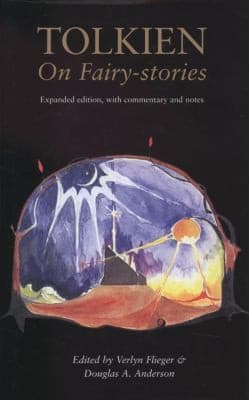
On Fairy-Stories
عن القصص الخيالية
Des Contes de Fées
Editorial summary
This essay examines the nature and value of fairy-stories, defending them against dismissal as mere children's entertainment while exploring their deeper theological and philosophical dimensions. Tolkien argues that fairy-stories represent a legitimate literary form that addresses fundamental human desires and offers unique insights into reality through the medium of fantasy. His analysis contributes to theological aesthetics by proposing that human creative activity participates in divine creation.
Central to Tolkien's argument is the concept of "sub-creation," whereby the fairy-story writer constructs a "Secondary World" possessing internal consistency and commanding "Secondary Belief" from readers. This creative act, he contends, reflects humanity's status as beings made in the image of a Creator-God. The essay thus presents artistic creation as inherently theological, suggesting that the human impulse to make new worlds through language and imagination derives from and honors the divine creative act. Tolkien explicitly rejects the view that fantasy represents escapism or deception, arguing instead that good fairy-stories can convey profound truths through their fantastic elements.
The work develops a theory of "eucatastrophe" - the sudden joyous turn in a story that provides consolation and hope. Tolkien identifies this narrative structure as reflecting the deepest pattern of Christian revelation, particularly the Incarnation and Resurrection. He argues that the Gospels contain the greatest eucatastrophe, where myth becomes history while retaining its mythic power. This analysis positions fairy-stories within salvation history, suggesting they can prepare hearts for religious truth by awakening desires that only the divine can ultimately fulfill.
Tolkien's essay engages with modernist skepticism about religious narrative and Enlightenment rationalism's devaluation of imagination. Against those who would reduce religion to ethics or fairy-stories to childish wish-fulfillment, he defends both as addressing genuine human needs for wonder, hope, and transcendence. His methodology combines literary criticism with philosophical theology, drawing on his expertise in medieval literature and philology.
The essay's significance lies in its sophisticated defense of religious imagination against secular reductionism. By theorizing how human creativity participates in divine creativity, Tolkien provides a theological framework for understanding art's spiritual dimensions. His work influences subsequent discussions about narrative theology, the relationship between myth and truth, and literature's capacity to mediate transcendent meaning in an increasingly disenchanted age.
Argument formulations engaged
Related works
Tolkien, J. R. R. (1947). On Fairy-Stories.
@book{on-fairy-stories-1947,
  author    = {Tolkien, J. R. R.},
  title     = {On Fairy-Stories},
  year      = {1947},
  url       = {https://god-database.com/en/works/on-fairy-stories-1947}
}