
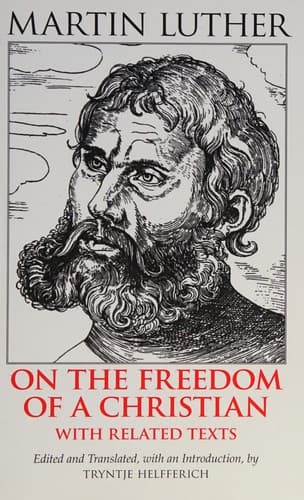
On the Freedom of a Christian
في حرية المسيحي
De la liberté du chrétien
Editorial summary
Luther's "On the Freedom of a Christian" articulates a revolutionary theological vision that fundamentally reconceptualizes the relationship between God and humanity through the doctrine of justification by faith alone. Written in 1520 during the early phase of the Reformation, this treatise presents Luther's mature understanding of Christian liberty while directly challenging the medieval Catholic synthesis of faith and works.
The work develops around Luther's famous paradox: "A Christian is a perfectly free lord of all, subject to none. A Christian is a perfectly dutiful servant of all, subject to all." This dialectical formulation grounds Luther's entire theological project. He argues that through faith alone, believers receive Christ's righteousness and become united with him in a "joyful exchange" whereby Christ takes on human sin while believers receive his perfect righteousness. This union, Luther contends, liberates Christians from the law's demands and the necessity of meritorious works for salvation.
Luther's theological method combines biblical exegesis with existential analysis of the human condition before God. He systematically dismantles the scholastic framework that understood grace as a quality infused into the soul, replacing it with a forensic understanding of justification as God's declaration of righteousness. The treatise particularly targets the medieval penitential system and the theology of merit, arguing that these structures obscure the gospel's promise of free grace and burden consciences with impossible demands.
The work's significance for debates about God lies in its radical reconception of divine-human interaction. Luther presents God not as a distant judge demanding satisfaction through human achievement, but as one who freely gives righteousness through Christ. This shift fundamentally alters discussions about human agency, divine sovereignty, and the nature of salvation. By locating righteousness entirely outside human capacity in God's gracious act, Luther challenges both medieval Catholic theology and emerging humanist confidence in human potential.
Luther's argument that good works flow naturally from faith rather than contributing to justification reshapes ethical discourse about divine commands and human response. His insistence that Christians serve others not to gain God's favor but because they already possess it through faith revolutionizes understanding of religious motivation and moral action. This treatise thus establishes key parameters for Protestant theology while profoundly influencing subsequent Western thought about freedom, conscience, and the individual's standing before God.
Argument formulations engaged
Related works
Luther, Martin (1520). On the Freedom of a Christian.
@book{on-the-freedom-of-a-christian-1520,
  author    = {Luther, Martin},
  title     = {On the Freedom of a Christian},
  year      = {1520},
  url       = {https://god-database.com/en/works/on-the-freedom-of-a-christian-1520}
}