
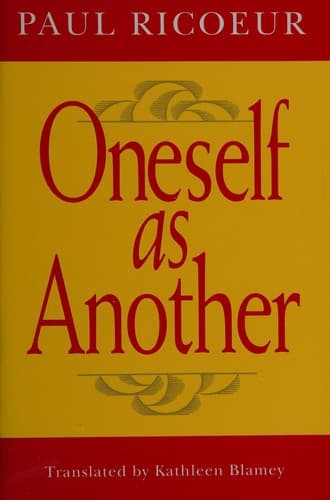
Oneself as Another
الذات كآخر
Soi-même comme un autre
Editorial summary
Ricoeur's Oneself as Another represents a major intervention in philosophical anthropology that bears significant implications for theological discourse. The work develops a hermeneutical approach to selfhood that navigates between the extremes of Cartesian self-certainty and Nietzschean dissolution of the subject. Through this middle path, Ricoeur articulates a conception of human identity that remains open to transcendence while avoiding both dogmatic assertion and reductive naturalism.
The monograph unfolds through a systematic engagement with the aporias of personal identity, examining how the self emerges through its relation to alterity at multiple levels. Ricoeur distinguishes between idem-identity (sameness) and ipse-identity (selfhood), arguing that authentic selfhood necessarily involves openness to the other. This otherness manifests in three primary dimensions: the otherness of one's own body, the otherness of other persons, and the otherness of conscience. The third dimension proves particularly significant for questions of transcendence, as Ricoeur explores how conscience testifies to a call that comes from beyond the self without determining its ultimate source.
Methodologically, Ricoeur employs a hermeneutical phenomenology that draws on linguistic analysis, narrative theory, and ethical reflection. He engages critically with analytical philosophy of mind, particularly Parfit and Strawson, while also incorporating insights from Levinas, Heidegger, and Aristotle. This interdisciplinary approach allows him to develop a nuanced account of selfhood that resists both substantialist metaphysics and purely constructivist approaches.
The work's theological significance emerges most clearly in its treatment of attestation and testimony. Ricoeur argues that self-understanding always involves a dimension of belief or confidence that cannot be fully grounded in epistemic certainty. This attestation opens a space for religious faith without requiring it, suggesting that human existence inherently points beyond itself without dictating the nature of that beyondness. His analysis of the ethical relation to the other, influenced by Levinas but critically modified, provides resources for thinking about divine alterity without collapsing into ontotheology.
For contemporary debates about God, Ricoeur offers a sophisticated framework that neither presupposes nor excludes religious commitment. His emphasis on the hermeneutical nature of existence suggests that questions of ultimate meaning, including the question of God, arise from within human self-understanding rather than being imposed from without. This approach has proven influential for theologians seeking to articulate faith in dialogue with postmodern critiques of metaphysics.
Argument formulations engaged
Ricoeur, Paul (1992). Oneself as Another.
@book{oneself-as-another-1992,
  author    = {Ricoeur, Paul},
  title     = {Oneself as Another},
  year      = {1992},
  url       = {https://god-database.com/en/works/oneself-as-another-1992}
}