
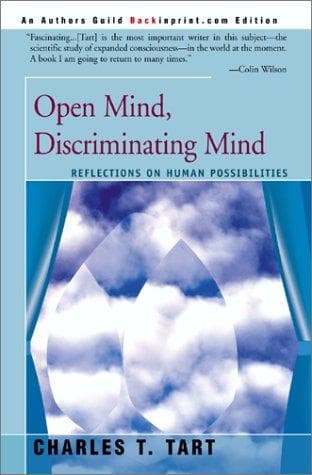
Open Mind, Discriminating Mind
العقل المنفتح والعقل الناقد
L'Esprit ouvert, l'esprit discernant
Genuine inquiry into consciousness and spiritual experience requires both an open receptivity to anomalous data and a rigorous discriminating rationality that resists credulity.
Editorial summary
Charles Tart's "Open Mind, Discriminating Mind" presents a careful examination of how scientific and contemplative approaches to consciousness might inform discussions about ultimate reality and the divine. Writing in 1989, Tart draws on his extensive background in transpersonal psychology to explore the methodological challenges facing any serious investigation of spiritual claims. The work emerges from a period of increasing dialogue between Western science and Eastern contemplative traditions, positioning itself as neither dismissive of religious experience nor uncritically accepting of metaphysical assertions.
Tart's central contribution lies in his systematic analysis of what he terms the "pathologies of knowledge" that afflict both scientific materialism and uncritical spirituality. He argues that genuine inquiry into consciousness and its implications for understanding reality requires cultivating two complementary capacities: an open mind willing to consider phenomena beyond conventional materialist frameworks, and a discriminating mind capable of rigorous evaluation of experiential claims. This dual emphasis distinguishes his approach from both reductionist accounts that dismiss spiritual experience as mere brain states and from naive acceptance of every reported mystical insight.
The work engages primarily with consciousness-based arguments about the divine, examining how altered states, mystical experiences, and contemplative practices might serve as legitimate sources of knowledge about reality's fundamental nature. Tart critiques the tendency within mainstream psychology to pathologize or explain away such experiences while simultaneously warning against the opposite error of assuming all spiritual experiences point toward identical metaphysical truths. His analysis draws extensively on case studies from parapsychology, meditation research, and cross-cultural studies of religious experience.
Methodologically, Tart advocates for what he calls "state-specific sciences," proposing that certain knowledge claims about consciousness and reality can only be adequately evaluated from within particular states of awareness. This position challenges conventional scientific epistemology while maintaining commitment to empirical rigor. He suggests that the question of divine reality cannot be resolved through ordinary consciousness alone but requires systematic exploration of multiple states of awareness combined with careful phenomenological analysis.
The monograph's significance lies in its sophisticated attempt to chart a middle path between dogmatic materialism and uncritical spirituality. Tart demonstrates how serious engagement with consciousness research necessitates reconsidering fundamental assumptions about knowledge, reality, and the possibility of the transcendent, without predetermined conclusions about God's existence or nature.
Structured analysis
Argument formulations engaged
Tart, Charles (1989). Open Mind, Discriminating Mind. Harper & Row.
@book{open-mind-discriminating-mind,
  author    = {Tart, Charles},
  title     = {Open Mind, Discriminating Mind},
  year      = {1989},
  publisher = {Harper & Row},
  url       = {https://god-database.com/en/works/open-mind-discriminating-mind}
}