
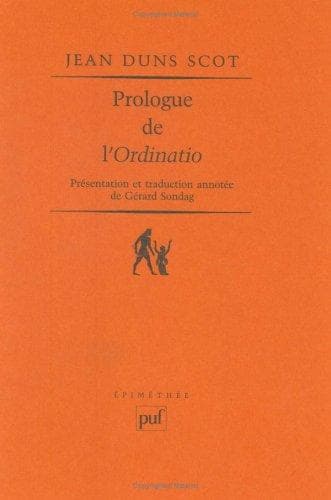
Ordinatio
الترتيب
Editorial summary
The Ordinatio represents Duns Scotus's systematic theological commentary on Peter Lombard's Sentences, serving as his definitive statement on fundamental questions of philosophy and theology. Written during his tenure at Oxford and revised until his death, this work advances distinctive positions on divine nature, knowledge, and the relationship between reason and revelation that significantly shaped subsequent medieval thought.
Scotus develops his famous doctrine of the univocity of being, arguing that the concept of being applies in the same fundamental sense to both God and creatures. This position challenges the analogical predication favored by Thomas Aquinas, enabling more direct philosophical discourse about divine attributes. Through this univocal conception, Scotus maintains that natural reason can achieve genuine, if limited, knowledge of God's existence and nature without depending entirely on revealed theology.
The work presents Scotus's influential demonstration for God's existence through the concept of infinite being. Rather than proceeding from motion or causation as Aquinas does, Scotus argues from the possibility of an absolutely first efficient cause to the necessity of an actually infinite being. This proof emphasizes God's infinity as the primary divine attribute from which other perfections follow, marking a significant departure from earlier scholastic approaches.
Scotus introduces his doctrine of formal distinction, arguing that divine attributes are formally distinct from each other and from divine essence while remaining really identical. This subtle position attempts to preserve both divine simplicity and the meaningfulness of distinct attributions to God. The formal distinction becomes crucial for explaining how human intellect can conceive different aspects of divine reality without compromising God's absolute unity.
The Ordinatio also develops Scotus's voluntarist emphasis on divine freedom and will. Against intellectualist accounts that subordinate will to intellect, Scotus argues for the primacy of will in both divine and human action. God's creative act stems from absolutely free choice rather than intellectual necessity, establishing contingency as a fundamental feature of created reality.
Throughout the work, Scotus engages critically with his predecessors, particularly Henry of Ghent and Thomas Aquinas, while drawing on Aristotelian philosophy and Augustinian theology. His rigorous logical analysis and innovative metaphysical distinctions establish new parameters for discussing divine nature, influencing later medieval philosophy and early modern thought. The Ordinatio thus stands as a pivotal contribution to natural theology, demonstrating reason's capacity to investigate divine reality while acknowledging its limitations.
Argument formulations engaged
Related works
Scotus, Duns (1308). Ordinatio. Fordham University Press.
@book{ordinatio-1308,
  author    = {Scotus, Duns},
  title     = {Ordinatio},
  year      = {1308},
  publisher = {Fordham University Press},
  url       = {https://god-database.com/en/works/ordinatio-1308}
}