
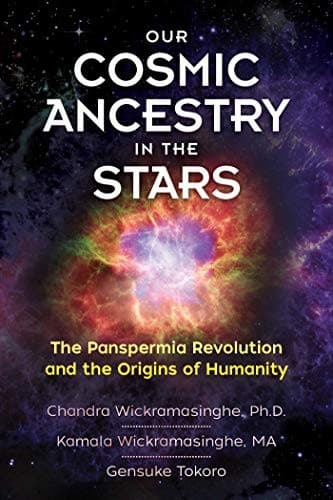
Our Cosmic Ancestry in the Stars
أصلنا الكوني في النجوم
Notre ascendance cosmique dans les étoiles
Editorial summary
This monograph presents a comprehensive defense of panspermia theory, arguing that life on Earth originated from cosmic sources rather than through terrestrial abiogenesis. Wickramasinghe, a long-time collaborator of Fred Hoyle, synthesizes decades of astronomical observations, microbiology research, and mathematical modeling to support the hypothesis that biological material pervades the universe and continuously seeds planetary systems.
The work challenges conventional origin-of-life theories by presenting evidence from multiple disciplines. Wickramasinghe examines spectroscopic data from interstellar dust clouds, demonstrating organic molecular signatures consistent with biological degradation products. He analyzes the survival capabilities of extremophile organisms under space conditions, citing experiments showing bacterial spores' resistance to radiation and vacuum exposure. The author particularly emphasizes the detection of complex organic molecules in cometary material and meteorites, arguing these findings support extraterrestrial biological origins.
Central to Wickramasinghe's argument is the mathematical improbability of life arising spontaneously on Earth within available timeframes. He calculates the odds of random assembly of functional proteins and genetic sequences, concluding that cosmic timescales and volumes provide necessary probabilistic resources that Earth alone cannot offer. The monograph critiques terrestrial abiogenesis models, particularly RNA world hypotheses, as insufficiently supported by experimental evidence.
The work's theological implications emerge through its treatment of cosmic purpose and design. While not explicitly invoking divine action, Wickramasinghe's framework suggests a universe inherently structured to generate and propagate life. This perspective challenges both traditional creationist accounts and purely mechanistic evolutionary narratives. The author proposes that life represents a fundamental cosmic phenomenon rather than an accidental terrestrial occurrence.
Wickramasinghe addresses objections from mainstream biology and astronomy communities, acknowledging the controversial nature of panspermia while defending its explanatory power. He discusses recent discoveries of organic compounds in space and microbial survival in extreme environments as vindication of earlier predictions. The monograph contributes to debates about life's ultimate origins by expanding the spatial and temporal context beyond Earth, raising questions about cosmic teleology and the universe's biological potential. This work matters for the God debate by offering a naturalistic yet quasi-purposive account of life's origins that occupies middle ground between strict materialism and traditional theism.
Argument formulations engaged
Chandra, Wickramasinghe (2019). Our Cosmic Ancestry in the Stars. Bear & Company.
@book{our-cosmic-ancestry-in-the-stars-2019,
  author    = {Chandra, Wickramasinghe},
  title     = {Our Cosmic Ancestry in the Stars},
  year      = {2019},
  publisher = {Bear & Company},
  url       = {https://god-database.com/en/works/our-cosmic-ancestry-in-the-stars-2019}
}